Saturday, July 13, 2024

Pemba Island: Kisiwa kwa Karafuu - The Clove Island

CHAKE CHAKE, PEMBA ISLAND, ZANZIBAR

MONDAY, July 8 

After an early morning meetup and a quick 20-minute flight, we transferred to Pemba Island – the second but much smaller of the two main Zanzibari islands. Pemba is more hilly and lush than Unguja. The waters around the two islands differ as well - lying closer to the mainland, Unguja sits on the continental shelf and is surrounded by relatively calm, shallow waters. It lends itself to safe and easier fishing and marine tourism, but it makes it susceptible to pollution and environmental degradation. Pemba, on the other hand, is close to the shelf's edge and has deeper water and stronger currents. It gets only a small fraction of Zanzibar's tourists, so I feel lucky to get to spend time here!

Exploring Pujini Ruins


Since we arrived early in the morning, we went directly on an excursion to see the ancient Swahili settlement known as the Pujini Ruins. This 15th century site was the fortified palace of the (possibly) Iranian ruler Mkama Ndume (although Rashid believes he was most likely Swahili – the storytelling tradition likes to make connections with the Middle East, since it elevates the Swahili’s position as Muslims.) Regardless, he was a strong ruler and his fortress is now an important archaeological site. 
I wanted to put him in my pocket, but I refrained
She's so pretty! (and he's so puny!)

Nature has definitely taken back her dominance at Pujini; most of the fortress walls have eroded through time, and we could only just make out the basic foundation of the complex. In the overgrown ruins, we saw pied crow and sunbirds flitting around the trees. We also found a giant millipede and a large red-legged orb weaver (and her little teeny tiny mate!)


Debatable if we were of any help...

Playing with Snapchat filters
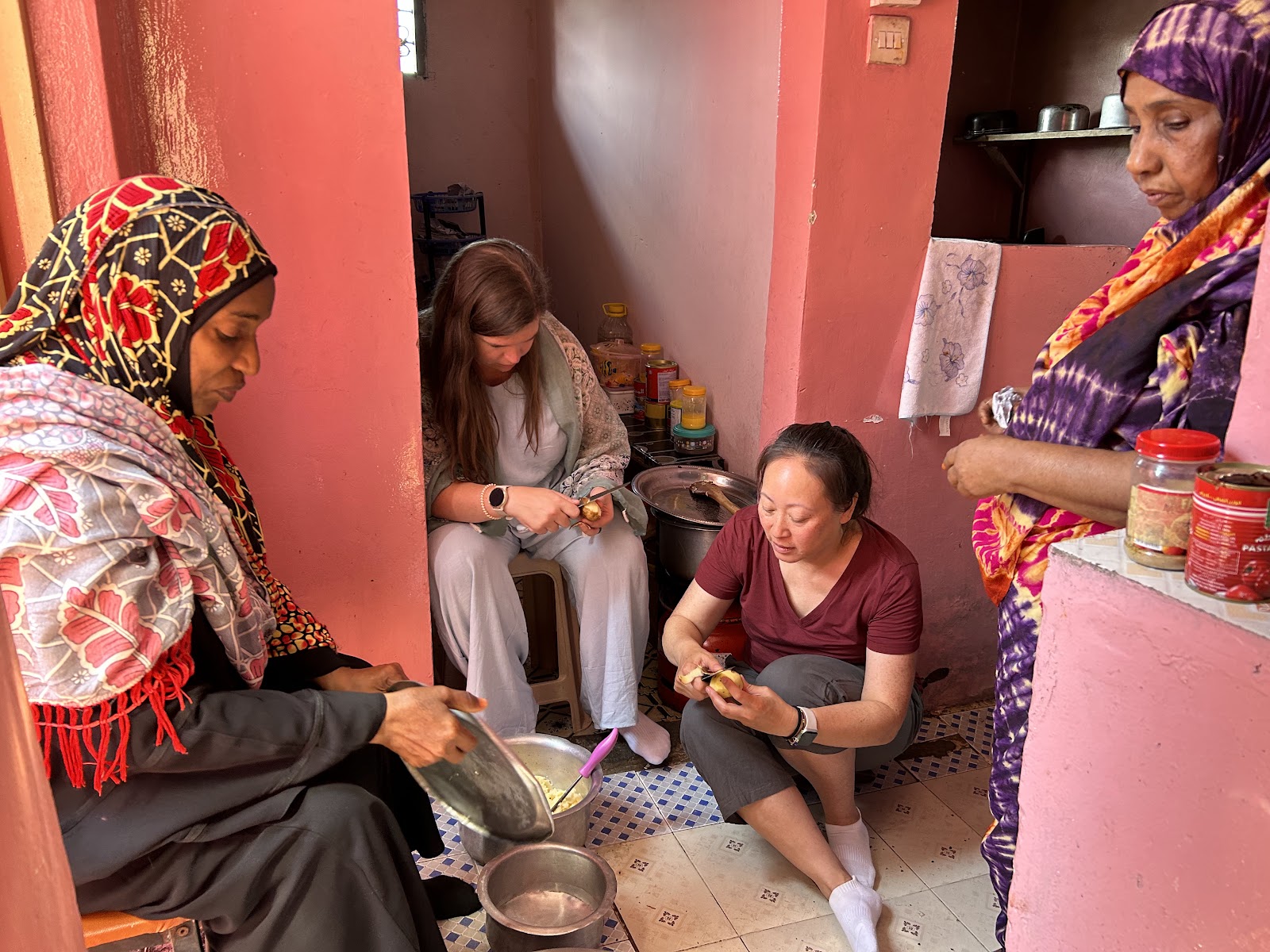
For lunch, we traveled to the home of Bibi Moza, where we “helped” her cook kachori – fried mashed potato balls (and they were SO GOOD!) It was fun having lunch at her home – we also met her grandson Farhoud, who played around with my Snapchat filters and then I showed a game on my phone. They were so warm and welcoming – like everyone else we’ve met in Zanzibar.

After lunch we checked into the Pemba Island Hotel in downtown Chake Chake - Pemba's biggest city (with just one stoplight), and had our last Swahili lesson with Schwena. We spent some time on group reflections regarding our time so far, then had dinner (again made by Bibi Moza) on the roof of the PIH.

A marriage license is required for 
couples who want to share a room
Pemba is much less visited than Unguja, and we were asked not to take photos while on the streets. The vast majority of people are conservative Muslims - the hotel doesn't allow alcohol or unmarried couples. We saw no other tourists here, and the people working at the hotel speak very little-to-no English. It feels much more authentic than the more touristed Stone Town - we'll get a much more local experience!

TUESDAY, July 9

On the drive north

Pemba Island is lush and green, its soil is nutrient-rich because of its volcanic origins. The land is hilly, allowing for drainage, so many people own farms - shambas - on Pemba. Much of the northern part of Pemba Island is covered in forest, so we headed up to visit for the day. Along the drive, we could see the agricultural land as well as the many hills and valleys of the island.
Our destination was the Ngezi-Vumawimbi Nature Forest Reserve where we learned about some of the challenges of forest conservation - not only is there illegal logging, but the local communities use the forest for traditional practices like using lumber to make charcoal. 

The bleeding red mahogany tree
We took a 2 km forest walk to see several endemic tree species, including the Pemba palm and the red mahogany tree (that looks like it bleeds when you cut open the bark!) 


During the walk we also saw several open spaces where water collected to form freshwater ponds (although they are being threatened by rising sea levels and warming temperatures.) The forest is technically a step below a rainforest since it doesn’t have quite enough precipitation – although it looked a LOT like the rainforest we saw in Costa Rica.


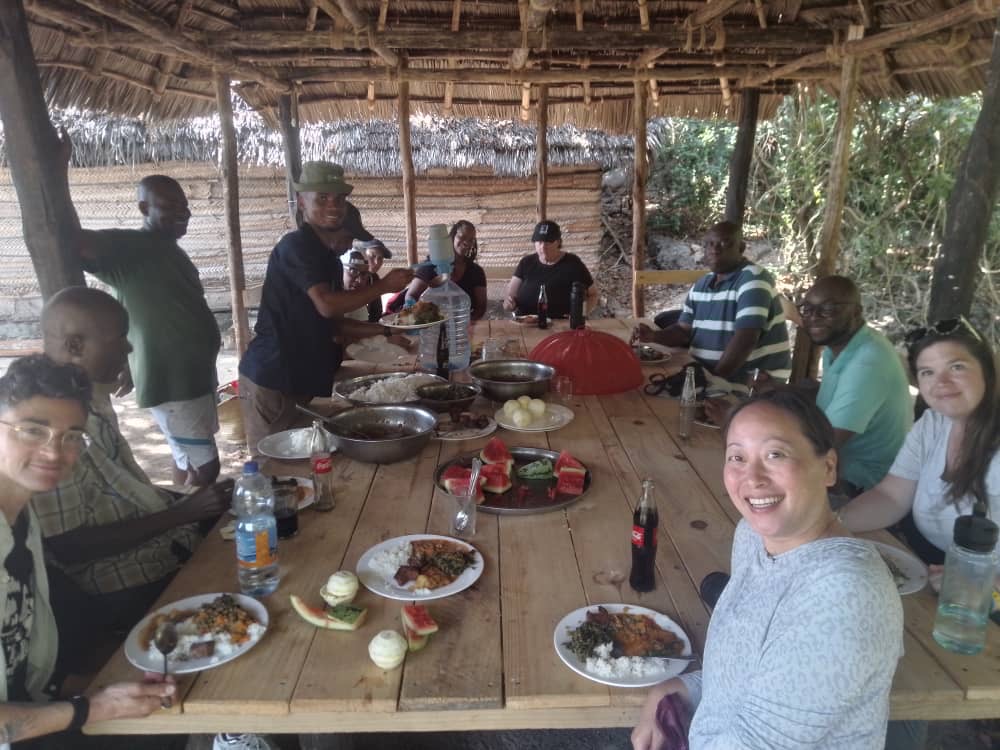
Lunch was at Vumawimbi Beach, a beautiful strip of white sand that was all but deserted. Hundreds of ghost crab holes covered the beach, and along the low-tide line we found brittlestar, pincushion sea star, and jellyfish. I tried my hardest to catch a crab, but it was astounding how fast they darted around on the sand!
It's just a constellation of stars!


He looks just like a Haeckel's drawing!
When it got too hot, we wandered back under the treeline for shade, and discovered a troop of vervet monkeys had come to scavenge our leftovers. While they initially wanted to keep their distance, they were bold in their exploration of the area and let us come fairly close, allowing us to take photos.

It was nice that we now have our afternoons free to relax, wander, and do some work, as many of us are exhausted (both from the time change and the relentless heat). When we got back to the hotel, Ann was on a mission to find bungo – the tart fruit that we’ve had in juice form for many days and that we all love. We wandered down to the local market, but it was towards the end of the day and many of the stalls were closing up. We wandered around a bit, which was nice since it felt like a true local experience – tourists rarely come to Pemba and we haven’t seen any other foreigners during our time here.

We ran into Rashid at the market across the street from our hotel, where we discovered our new favorite soda – apple punch. We also bought the stale popcorn on Rashid’s recommendation (it wasn't really that stale), as well as some fresh local dates that were delicious. It was nice getting to interact with the locals (and to practice our Kiswahili).

WEDNESDAY, July 10

The rice fields of Pemba
We had a wonderful day today learning about the reforestation of Kokota and Pemba Islands through an NGO called Community Forests Pemba. The organization focuses on the restoration and protection of forests, but understands the economic challenges faced by the community and addresses those needs in order to help people support conservation efforts. For example, locals may cut down the forest for firewood and to sell the timber for money, because they need to support their families. Unless their economic needs are addressed, they can’t afford to be conservationists. CFP helps community members to change to spice farming, to support and promote vegetable and fruit production, and to improve their standard of living.

Slogging through the sole-sucking mud.
Get it? SOLE sucking?...
After hearing their presentation, we went out to the marsh near the village of Gando to help plant mangrove propagates. Rashid and Said bought us wet shoes (knockoff crocs that we’d wear once then donate to the local community). We walked down to the marsh area, where in the low tide we carefully made our way through the muck to the planting area. 
We had to carefully step since some areas were soft and dangerously sticky – I stepped out of line and sank down to almost my knee, almost losing my shoe in the process - thanks Said, for rescuing it!

🦀 Craaaaaabs! 🦀

The exposed sand was absolutely crawling with fiddler crabs – it was fun to see them scurrying around, ducking into their holes. There were so many that it sometimes seemed as though the ground was alive! Did you know? Only the male fiddler crab has one giant claw - it can be up to half the crab's body weight! 

Mangroves have uniquely adapted to the dramatically shifting water levels caused by the tides. Their seed pods are torpedo-shaped, with the bottom being heavier than the top. The pods begin to germinate on the tree, then drop when they are ready. If the tide is out, the spear-like pod will stick into the mud, quickly taking root within 4 hours. This way, they won’t get washed away by the incoming tides. Pods that don’t stick into the mud are washed away by the current, and some end up rooting in other places (thus dispersing the mangrove plants).

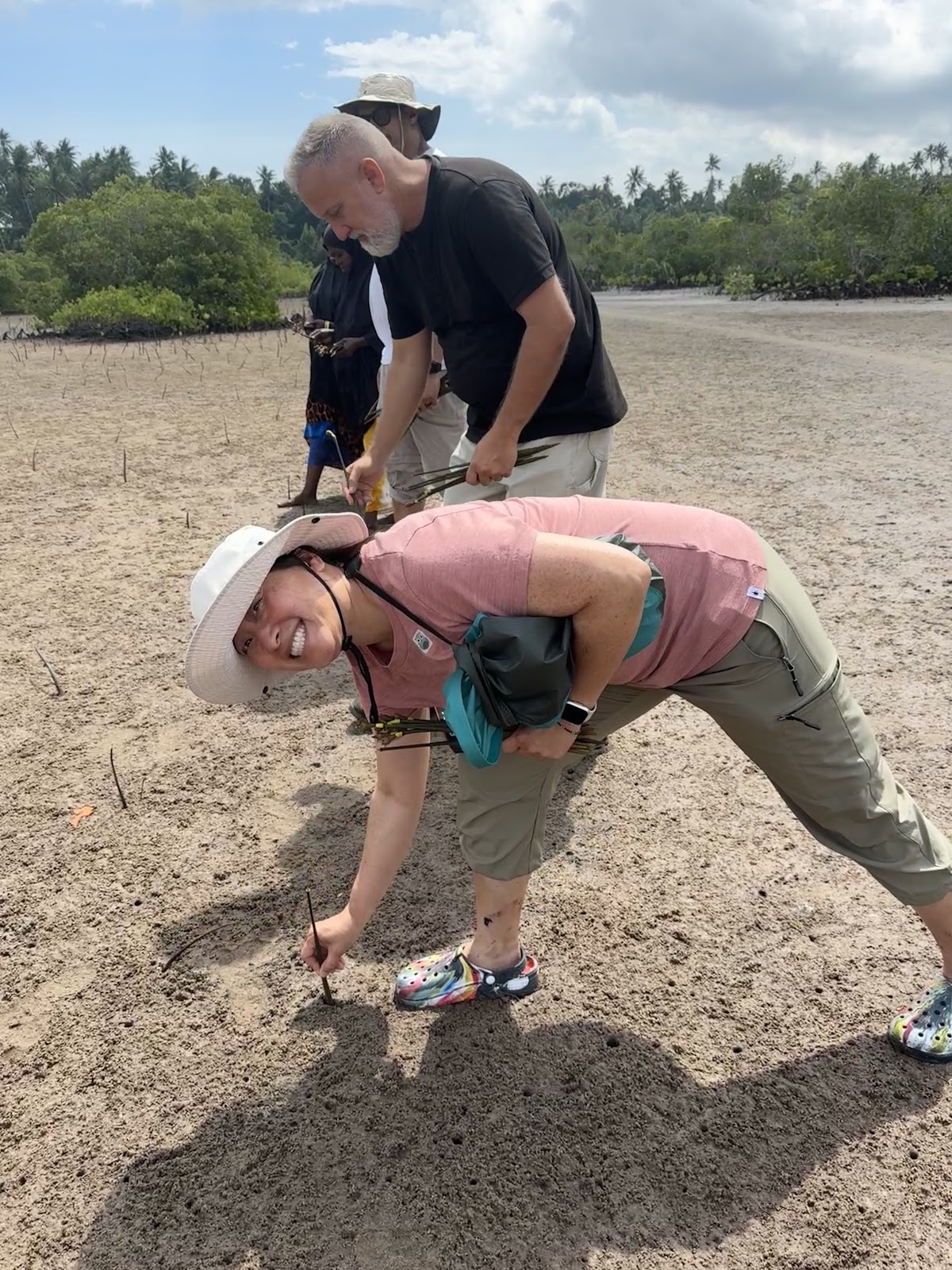
We each took a handful of seed pods and lined up to plant. We spaced ourselves a meter apart, and stabbed each propagule 3 inches into the mud, then took a large step and planted our next propagule. Although we didn’t spend much time planting, it was easy to see how a group effort could easily plant thousands of seeds in a planting session!

THURSDAY, July 11

Yesterday we learned about forests, and today we learned about agriculture and sustainable techniques for maximizing land use. 

We visited master farmer Amour, who also holds the position of Head of Agricultural in the Zanzibar Archipelago. His farm is intelligently managed – he uses techniques that help combat fluctuating water availability, creates and manages his own fertilization, and even plants certain crops as a pest management technique (his ‘best’ and sweetest mangoes are not meant to be harvested – instead, he sacrifices them to draw insects away from his other mangoes, which are then left alone by the bugs!!) 

The sustainable "fertilizer factory"
Amour has experimented for years, trying out different methods to see what works. He once drove a truck out to the demolition of a building that hosted a colony of bats, just to collect the guano since he knew it was rich in nutrients. His current fertilizer is made by keeping a small herd of cows, mixing their dung with urine and chicken poop and using it in his fields. It works so well that others want to buy his fertilizer (but it's too valuable to sell!) With years of experimentation, his farm is thriving and he hosts workshops so that other farmers can learn his techniques.

Interestingly, on the walk to the farm we passed a family making charcoal - the traditional fuel used by most homes in Zanzibar to cook their food. It's not environmentally sustainable but it is inexpensive, as most homes don't have the infrastructure for natural gas or electricity. 


After lunch at a guest house in Wete (the second largest city on Pemba, and location of the only other stoplight on the island), we stopped to see a roost of the endemic Pemba flying fox. The roost we saw had HUNDREDS of individuals, and although the flying fox is normally a nocturnal animal, we were able to see a few flying around. Seriously, guys. IT WAS SO COOL!

Did you know? The Pemba flying fox is endemic to Pemba Island - that means it can't be found anywhere else in the world. It's called a flying fox because of the big eyes, pointy nose, and furry little ears that make it look like a fox, but it is really a type of bat - one of the largest bats in the world. It has a wingspan of up to 5.5 feet across - (bigger than me!!) - but they usually weight only about 1.3 pounds. Pemba flying foxes are nocturnal, and mainly eats fruit like mangoes and figs. Because of this, they disperse seeds and help keep the forest healthy. 

FRIDAY, July 12

With an entire morning free, I tried to sleep in (unsuccessfully – woke up at 3AM! 😭) but had a nice, leisurely breakfast. It was raining hard all morning, which kept the temperature (and bugs) down, and we decided despite the rain to venture out to see a spice farm. After all, we are on the Spice Islands! Ann, Allie, Rubin and I went to 1001 Organic Spice Farm and took a small walking tour through the small forest. We saw pretty much all the spices grown on the island: clove, ginger, cinnamon, turmeric, vanilla, pepper, ylang ylang, curry, cardamom, and other plants and fruit. Afterwards, we bought several packets of spice – I got cloves, cinnamon powder and sticks, and black peppercorns – all for 20,000 tsh.

That afternoon, we received comfortable flowy dresses from Bibi Moza (known as Bimoza). We changed into them for our celebration with the local Pemba host moms, who normally house the SIT students during the semester. We danced to traditional Dufu music (full of drums and chanting) and had a lovely time dancing with the moms. 

That evening, we had a quick transition to the Pemba airport, a 20 minute flight to Unguja to pick up more passengers, then a 15 minute flight to Dar Es Salaam – the largest city in Tanzania. It was raining when we arrived, and a jarring transition from the quiet island life of Pemba to the huge metropolis that is Dar. Traffic – particularly in the rain – was horrendous, and it was past 9PM when we finally arrived at the mega-mall near our hotel where we would grab dinner. (btw, walking through the mall was such a culture shock after the peaceful, rural existence on Pemba. Our eyes were huge and mouths agape, as though we hadn’t seen civilization in months rather than just a few days. Such dichotomy is truly jarring!) 


Monday, July 8, 2024

Snorkeling, some Sand, and a bit of Sewing

THURSDAY, July 4

On the way to Chumbe!
The day was spent on an excursion to nearby Chumbe Island, a marine protected area and forest reserve. It was an amazing day where we experienced so many different biomes and explored many ecosystems! 

As we waited to embark the boat for our journey, we explored the mangrove forest that was exposed due to the low tide. There were many small propagules that were just beginning to sprout, as well as mangrove 'knees' - the specialized roots that stick up above the water that help the tree to breathe. In the shallows of the beach, we could find many pen worm holes as well as the swirling egg clusters of some type of mollusk. "Keep your shoes on!" we were warned as we waded through the ankle-deep waters to reach the boat - who knew what was hiding in the algae-covered mud.

The exposed beach at low tide
After a short 45 minute boat ride, we arrived at Chumbe – the receded tide exposed the undercut limestone coastline of the island. This really spotlighted the vast difference between high and low tides, as well as the power of wave action. We waded through the water to get ashore, keeping our shoes on since there were hidden sea urchins, poisonous cone shells, and jagged coral rocks. We even found a sea hare, cleverly disguised to look just like the rocks, who had squirted his purple-black ink in defense when he’d been stepped on. 

(As an added bonus, as we walked to the Education building I saw a Speckled Green Tree Snake on the path!! It was a gorgeously vivid emerald - Rashid said they eat primarily geckos.) 

Ready to snorkel!
After a quick tour of the facilities, we set off for our snorkeling tour. Just off the western side of the island is the marine protected zone, and one of the most pristine coral reefs in the area. While we did see signs of coral bleaching, the clear waters made it easy to see the vibrant colors of the amazing diversity of fish and coral species. There were schools of sergeant majors, colorful parrotfish, and pointy headed unicornfish. The water was warm and clear - a nice and easy place to snorkel!


African paradise flycatcher
After an absolutely amazing lunch (where we saw an African paradise flycatcher, with its turquoise eye ring and long elegant tail), we heard from the Education department – the funds from the ecolodge allow local children to visit the island and learn about the environment for free. 
 
Atop the lighthouse
We then had a quick walk through the terrestrial forest, interesting because of the coral rag that makes up the foundation of the forest floor. Many crevices pock-mark the ground – a great habitat for the coconut crabs that live on the island (sadly, we didn’t see any since they are primarily nocturnal). We also climbed up to the top of the 112 ft tall lighthouse, built in 1904 by the British to help aid in navigation around Zanzibar Channel. There's a great view from the top, looking all the way across to the mainland!

High tide - that overhang we walked under is almost submerged!
Something not often discussed when we talk about climate change is that the changes and effects don’t necessarily cause negative impacts for everyone. We learned today while snorkeling around Chumbe Island that the coral reefs undergo bleaching events, which lead to a change in the surrounding ecology. This can be caused by various factors such as warming seas, pollution, ocean acidification, etc. Coral has a symbiotic relationship with tiny algae called zooxanthellae, who use photosynthesis to produce food. The coral provides a safe place to live, while the zooxanthellae provide nutrients with the coral. Zooxanthellae also give coral their vibrant colors. During a bleaching event, the zooxanthellae are expelled by the coral polyps, causing the coral to essentially starve to death. And when the coral dies, different algae begin to grow and take over the reef. But nature always tries to find a balance, and to combat algae, herbivorous fish are attracted to the area. If left untouched, these fish eat the algae - allowing the coral to return, and when there isn’t enough algae, the fish disappear. But fishermen like when there are lots of these fish, so they equate bleaching events with a better harvest. It becomes difficult to explain to them why climate change is a negative thing, when on a local level it is a boon for their economy. Definitely something to think about! 

FRIDAY, July 5 

We had the morning free before our afternoon Kiswahili lesson, so Ruben, Allie, Ann, Nicole, and I went with Rashid to the nearby sand bar to see more of the intertidal ecosystem. From the busy beach in Stone Town, we boarded a boat to take us the 30 minutes to the Pange Sand Bar. 

Before the arrival of the crowds
Pange – as with many of the other small islands and sand bars – has been taken over by tourists. (in fact, it has recently been renamed Nakupenda sand bar - "I love you" - and is a common destination for engagements.) It’s easy to see why – the pristine sands, clear aquamarine and cerulean blue water, and the shallow intertidal on the west side make for a relaxing and interesting day excursion. Dozens of hawkers were starting to set up their large canopy tents in preparation for the influx of tourists. They make lunch and sell souvenirs – and most likely dump their refuse into the water. 

There were so many sea stars!
I was so glad we left before 9:30AM because the island was fairly empty when we arrived (this was decidedly NOT the case when we left!!). Several long-spined sea urchins were drying on the sand, left stranded when the tide receded, so we were careful getting off the boat. I wandered around the intertidal area (and I even found some treasure – a most-likely fake Cartier bracelet!) We then spent a little time hanging out on the beach and wading into the warm Indian Ocean waters – we found a sea hare and several large 7-armed sand-sifting sea stars, and watched a fisherman spear an octopus.

😐
As the morning progressed, the beach got more and more crowded. Several Instagram models appeared - wearing clothes that were questionably appropriate for a family-friendly beach even in the US… Ann tried to photobomb one, but they wisely moved further down the beach. 

We returned to Stone Town for a traditional Swahili lunch, then had our next Kiswahili lesson. Again, Ann and I went into the other room for a private lesson, where we learned some advanced grammar that even our teachers said were sometimes not even used by the native speakers. But at least I’m improving, and getting some practice listening to other people’s conversations! At my homestay house, I even watched a kid’s cartoon of a fairy tale – the audio was in Kiswahili but it had English subtitles – and I found I could understand about a third of what they were saying!

SATURDAY, July 6 

Working with the women of SASIK
Today was spent working on our hands-on artifact – a creative item or project that we create with co-collaborators to express the theme of climate change. Ann, Allie, and I decided to work together to create a textile representing some climate theme. Our local collaborators were from the women's collective SASIK (named after the initials of the founder). We sewed quilt panels – I first wanted to create a crab with a spiral pattern (the spiral representing the circular patterns of weather, as well as being a common patten found in nature; the crab representing the ocean, as well as being a representation of our collaboration since Kat/Ann/Allie or KAA is Kiswahili for ‘crab’). 

Ok, so maybe I'm not great at this...
To simplify things (in my naivete), I changed my design to a spiral they already had a pattern for rather than trying to draw one from scratch. I soon learned that curves and complex shapes, like those found in my design, are hard to sew… so thank goodness I’m getting a lot of help from my artisan partner, Mashavu. We all found the process of spending time with these women to be more meaningful than the actual product - we chatted easily and got to know them, and heard their perspectives on how women are affected by climate change. We have until 5PM tomorrow to finish our project, and I’m 82.7% confident that I’ll make the deadline!


SUNDAY, July 7 

The finished products

We finished our artifact today and spend a little time sharing with the group as a whole. There some really creative pieces: T’Shango went to a traditional wood carver, Anne-Marie and Rubin worked with musicians, Jennice made a quilt with a seamstress, and Biko and Nicole both made videos. We’ll get to see everyone’s work tomorrow for a longer share time on Pemba. Because we finished with a little time to spare, Ann, Allie, and I took a walk around Stone Town – we tried to find streets and neighborhoods that we hadn’t explored before, but we kept ending up finding ourselves on familiar streets – the old town really isn’t very big, and even though the streets are small and winding, it’s basically impossible to get lost. 

It was our last night at our homestay, since we had an early morning flight to Pemba. When I got home, my host dad Suleman was in his small shop, so he invited me in to look around. It is a tiny neighborhood store about the size of a walk-in closet, with candy, drinks, spices, and basic necessities – Suleman explained that it is really just for the surrounding neighborhood. While I was there, two people came by and had a tiny cup of what I think was coffee that he poured out of a thermos – the cups were about the size of a shot glass, and no money exchanged hands. I’m not sure if he has any other income source, but I can’t imagine the store earns enough to keep a household of at least 5 people. But he was kind enough to gift me a vial of perfume and a large bag of baobab rock sugar, which has high nutritional content and is a great alternative to regular processed sugar. I’m excited to try it with tea! 

Wednesday, July 3, 2024

Tuko Pamoja - Together in Tanzania!

STONE TOWN, UNGUJA ISLAND, ZANZIBAR
SATURDAY, June 29

Jambo! I've made it to Zanzibar and am so excited to spend the next five weeks in Tanzania on a Fulbright-Hays project through SIT - the School for International Training. 11 educators, high school and university, are on the trip to learn about Tanzanian creativity and perspectives in an era of climate change.

* * * * * * * * * * DID YOU KNOW? * * * * * * * * * * *

The Zanzibar archipelago is a semi-autonomous region of Tanzania off its Eastern coast, comprised of many small and two large main islands: Unguja and Pemba. Zanzibar has its own government and President, but is part of the Tanzania nation (in fact, the President of Zanzibar is the Second Vice President of Tanzania - yes, there are two VPs). 

In 1964, after gaining independence from British colonial rule, Zanzibar united with the mainland area known as Tanganyika. So TANganyika and ZANzibar united to form the United Republic of TANZANIA. (mind blown!)

* * * * * * * * * * * * * * * * * * * * * * * * * * * * * * * *

I'd been emailing Rubin, an informal educator from San Francisco, in the days before our trip since we'd be flying out of SFO together. It made me feel better that they also had little information about how to prepare, and we muddled together through packing and sorting out our clothing, bags, visas, and malaria meds. Since Zanzibar is a predominantly Islamic island, we were instructed to wear dresses that covered our shoulders and knees. But we were also hiking along the base of Kilimanjaro, so we had to prepare for cold weather... we both ended up with huge bags, but at least we're prepared!

The Doha airport jungle
Our flight would first take us on a 15 1/2 hour slog to Doha, Qatar - which btw is an AMAZING airport that just won the "best in the world" award, and which we found to be well deserved. It made our 8 hour layover quite pleasant, especially since we were able to get a 'sleep pod' where we could nap or just relax in our own private little bunk rooms. We also spent time wandering around their indoor jungle - it was so cool!!

Exploring Stone Town with Ann, Rubin, and Biko
Rubin (and we later discovered Biko and Jennice) and I landed in Zanzibar at around 7:30 in the morning, which meant a whole day to rest and relax since the other half of the group wasn't arriving until 9 that night. We were met by Richard (known locally as Rashid), our fearless group leader, main instructor, and program director, who brought us to the Maru Maru Hotel, our home for the next 4 nights. Ann, who had been in Kenya right before this, arrived in the late morning, so we spent the day wandering around the streets of Stone Town to see the sights.

This is the only place in the world where the predominant building material is fossilized coral - an homage to the island's unique geologic history.  Millions of years ago, ancient coral reefs developed when the sea levels were higher. Tectonic activity created the East African Rift, leading to the formation of the Zanzibar Channel and separating the archipelago from the mainland. 

Stone Town is an old Swahili trading town on the central western coast of Unguja, Zanzibar's largest island. Because of its location on the edge of the Indian Ocean on the East African Coast, it was an important port for the trade of ivory, slaves, and spices (Zanzibar is also known as the Spice Islands). 

Old Town's personality is oozing with charm due to its cosmopolitan heritage - there are African, Indian, European, and Arabian influences in the architecture. Narrow streets lined with gorgeously carved wooden double doors (reminiscent of those I saw in India) maze their way through the town. Along the main streets, hawkers do their best to lure tourists into the shops by calling out the stereotypical "Hakuna Matata!" and "Jambo!" greetings. We soon discovered that it was easy to deter them by responding in Kiswahili: "Hapana, asante" (No, thank you) or "Sio leo" (Not today). According to Rashid, speaking simple Kiswahili meant we had been around for long enough to study the language, and therefore weren't just average tourists who would be interested in buying their common, generic souvenirs. 

In the old Omani Fort

But that didn't mean we didn't talk to shop owners. The custom and culture of the people is to take the time to meet and greet everyone you pass on the street, and everyone we met was open and friendly - especially if you took the time to speak Kiswahili. With my 3-ish months of Duolingo, I was in no way proficient in the language, but I was gradually learning some vocabulary and basic grammar. To a one, every waiter or waitress, hotel worker, and shopkeeper was patient and even eager to chat and listen to my muddled attempts at conversation.  In the souvenir stalls inside the Omani Fort (on Old Town's waterfront), I practiced reading the carved wooden signs with the shopkeeper, who quizzed me on Kiswahili vocabulary and taught me new words.

To me, this willingness to converse is a reflection of the importance that Zanzibaris place on community. Every individual is valued - Rashid explained how even people with disabilities are treated with kindness and grace - to the extent that schools with limited resources will still have a braille schoolbook, even if there aren't enough regular textbooks to go around. Every person is valued - just as it should be.

SUNDAY, June 30

Old Town walking tour
On our first full day of the Fulbright Hays program, I met the other 10 participants (6 University and 4 other high school instructors) and had a full day of learning. After an introduction to the program, we had a brief walk around Stone Town and lunch at an Indian restaurant in the Old Town. We then had our first Kiswahili lesson - and I was glad I'd been diligent with my Duolingo, as it gave me a great foundation and put me ahead. I'm hoping to get a more advanced lesson (along with Ann, who is actually conversant in Kiswahili so she might be way too advanced for me!) Lastly, we got a health talk that informed us of the unique tropical diseases that are present in Zanzibar and the mainland - malaria, cholera, and typhoid are all present, so we need to be vigilant to stay safe!

MONDAY, July 1

We began the day with presentations from the former head of the Department of the Environment, and the retired head of the Dept of Forestry and Non-renewable Natural Resources, to get a foundation for Zanzibar's policies on climate change and the challenges they are having due to unstable government support and lack of consistency. Sadly, each change in ruling parties means a shift in who administers the Ministry of Environment, which means it is difficult to enact and enforce policy.

Examining meteorological instruments with Dr. Kai
After lunch, we visited a meteorological station to understand the trends and the science behind Zanzibar's weather. Across the Indian Ocean, variable water temperature causes shifts in the weather patterns. Warm water heats the air above it, and as warm air rises, it causes a low pressure area under it. With a higher pressure area on the other side of the ocean, winds form and can develop into powerful tropical cyclones that push into East Africa. Lately because of climate change, there is a greater variability in temperature patterns - difficult if your livelihood is in agriculture and you depend on the weather. 

TUESDAY, July 2 

Chidi an' me on the hike
The topography on the way to Kuumbi Cave
We had a great day exploring Unguja Island! We began the day at Kuumbi Cave, an example of a cave created around 20,000 years ago in the underground limestone karst system underlying the island. Within the cave, archaeologists have found pottery fragments, bones (including human!), and other tools dating back thousands of years, including from the Stone Age and Iron Age. It is still used for religious rituals and is considered by the locals as a sacred place.

We then traveled to Jambiani to visit Ali, head of a seaweed collective. This NGO helps locals cultivate and farm seaweed, sponges, and coral in the shallow intertidal area on Unguja's southeast coast. This area stretches out almost 3 kilometers offshore, allowing farmers plenty of room to grow and harvest their crops. 

First time in the Indian Ocean!
Driving back from Jambiani across the island was along the unnamed highway from Paje to Jozani - one of the main roads that connects the east and west sides of the island. The road is disturbingly potholed, and we were constantly slowing and swerving to navigate. Apparently the government purposefully neglects to repair the road and instead, takes visiting dignitaries across it to show how "in need" the island is in an effort to pander for financial aide. And yet, if aid is donated, the money is not spent on the local community, so the people are the ones who suffer. Yikes...

Hiking through Jozani
After lunch (at a gorgeous seaside restaurant overlooking the Indian Ocean), we headed to the Jozani-Chwaka Bay National Park for a hike through the tropical limestone forest. The park is the largest remaining area of natural forest on the island, and includes tropical rainforest, coral rag forest, swamp forest, and mangrove swamps. 
Into the forest we go!

Look at his cool yellow spots!
Syke's monkey
We were lucky enough to see the endangered endemic Zanzibar red colobus monkey (one even carrying a baby!), as well as several Sykes' monkeys, sunbirds (who look like hummingbirds), a yellow-spotted tree frog, and tons of butterflies. We learned that erosion and rising sea levels will gradually submerge this area, turning Unguja into two separate islands... who knows how long that will be, but climate change will definitely speed the process!

WEDNESDAY, July 3 - Haile Selassie Secondary School, High View International School, and Homestay

Haile Selassie Secondary School
We visited two different schools on Unguja today to see the types of education offered on the island, and understand how climate change is being taught in classrooms. Our first stop was Haile Selassie Secondary School, a public (or "government") school, where we met with Hamid and two science teachers. In Zanzibar, high school students (Form 1-6) have general classes for the first 4 years, then specialize during Form 5 and 6. Because of various factors, only a very small percentage of students make it to Form 6.
High View International School 

Following our visit, we traveled down to High View International School - one of the top private schools in the country. The highlight was a visit to a Form 6 classroom, where students have been studying about climate change and where we had a Q&A session. One girl in particular was extraordinarily impressive - we found out later that she was class president, and we were all amazed by her poise and self-assuredness. She also answered more than half of the questions we posed to the students!

My dinner
We transitioned to our homestays that afternoon - an opportunity for us to meet a local Zanzibari family and experience their culture. It's really interesting being in a traditional home - we were given lots of preparation beforehand on what to expect, and everything was basically true (except I don't eat with the family - I pretty much eat by myself, unless one of the daughters sits at the table playing on her phone. Awkward!). I am with Suleman and his wife Ayisha (who speaks no English and, as far as I can tell, barely speaks at all). They have three daughters - the oldest Lamha is taking classes at the local university; Raghad works in a bank, and the youngest Sundus (known to the family as Bibiye) is 6. There is also a grandma living with the family who is the most talkative and engaging, but she was rarely upstairs where I was staying. 

My homestay house

Suleman's home is constructed in the traditional Swahili architectural style - two side-by-side doors from the outside lead to a workshop and a small shop; these are the street-facing rooms, but the house extends back much further and goes up three stories. The house surrounds a central courtyard that is open to the elements - known as an impluvial style of architecture, it is meant to catch rain and have a more private outdoor area that is in the interior of the home. My room is on the added third story, and it is large and comfortable with a large ceiling fan and a/c! 

Staying with a Zanzibari family should be an interesting and eye-opening way to see how real locals live - I'm excited for the next few days!