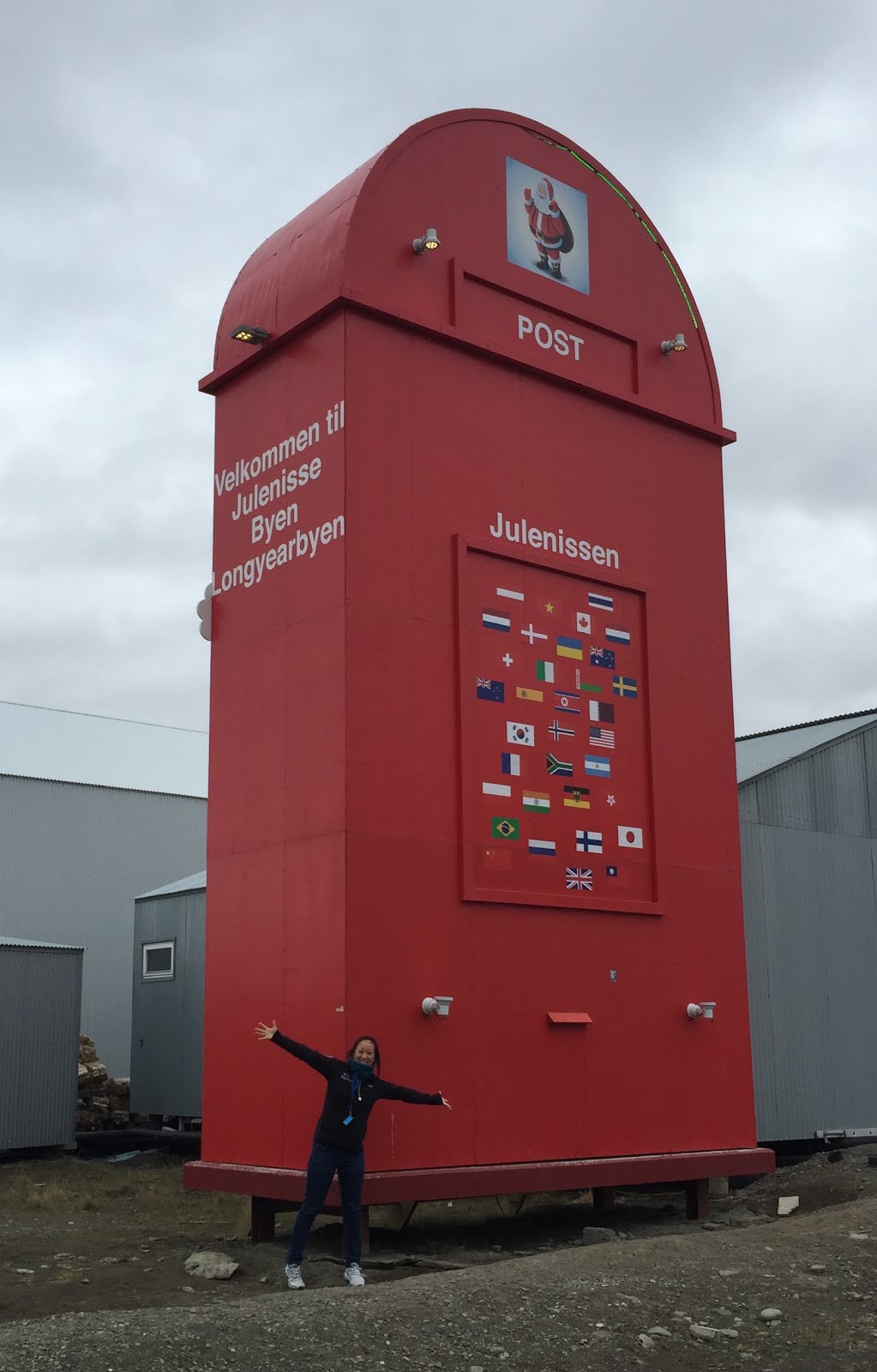
My Summer of Ridiculous Awesomeness just started, and I'm off to a great start. This week I've had the privilege of attending the
, held at the US Space and Rocket Center (USSRC) in Huntsville, Alabama. 100 teachers from around the globe are here for the 5-day Space Academy for Educators camp, learning about space and participating in various hands-on activities like astronaut training exercises, jet simulations, and space missions. Seriously! Space camp!!
I arrived on Wednesday afternoon and went directly to the USSRC for dinner before checking into the dorms at the University of Alabama, Huntsville. My roommates are Pauline (New Mexico), Jodie (New Mexico), and Nidhi (Pune, India), and we're all on the same crew: Team Destiny.
We were given lots of goodies - a backpack, water bottle, flash drive, three t-shirts, and a jumpsuit that we have to wear for many of our simulations.
 |
| Pauline, me, and Jodie trying on our jumpsuits |
THURSDAY
On our first full day, we met our fellow Destiny teammates. At camp, there are 100 educators from all over the world - including teachers from Australia, Finland, Mexico, India, and Romania in my group alone!
 |
We heard from Ed Buckbee,
founder of Space Camp and
friend of Wernher von Braun |
 |
| A tour of the grounds |
 |
| Team Destiny with astronaut Bob Springer |
We also saw the Saturn V rocket that first brought man to the moon, and had a lecture by Bob Springer, who flew on two different space shuttle missions (one of which is still classified, 25 years later... he'd tell us what he did, but then he'd have to kill us...)
 |
| Chillin' under a Saturn V Rocket... |
At the end of the night, we relaxed at the Biergarten, a weekly event held in the Saturn V Hall of the Davidson Center. It is amazing how many people can fit under a gigantic rocket!
FRIDAY
It was a day chock-full of team-building, critical thinking, and educational activities, but we couldn't be more excited. We have so much fun with the 15 people on Team Destiny, and we got to work together at the Low Elements course this morning doing teamwork exercises, a la low ropes course.

.
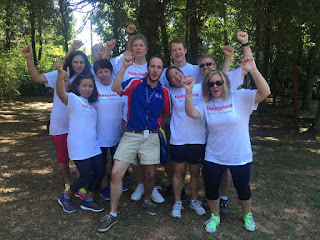
One of the best things about Space Camp is getting to go on our own missions into outer space. There is a mock-International Space Station (with orbiter and command center), and after a tour we did a prep-run of our Alpha mission.
 |
| We're in the ISS! |
We also built rockets (which we'll shoot off later in the week) and did an ECLSS lesson (Environmental Control and Life Support Systems) - essentially, things in the ISS environment need to be reused, so we had to find a way to filter urine into drinkable water.
We found out later that we
made the local news - and not only that, but our little group of friends (Beth, Lauren, Pauline, me, and Jodie) were the featured picture! Definitely the only moment when we weren't goofing off, and miraculously the camera caught us at the right time.
We ended the night with a truly meta- experience - watching the cheesy 80's movie "Space Camp" here at Space Camp!!!
 |
| Space Camp at Space Camp! |
SATURDAY
 |
| It was flippin' fun! |
Holy cow, we did so much amazing stuff today! It was mostly hands-on astronaut training activities, with an amazing mission thrown in for good measure. We started the day on the Multi-Axis Trainer, which gives astronauts the experience of disorientation in the event their crafts lose control. For the most part, you don't get too sick because your stomach stays centered and your head supposedly doesn't move in the same direction long enough for your ears to get wonky, but I still felt a bit woozy afterwards...
 |
| Parachute water landing... |
 |
| Getting pulled out of the water. |
After that, we had a quick presentation about getting radio time for schools to connect with the ISS, and then we went to the Aviation Challenge Water Survival activities. For this, we trained on what to do in the event of a parachute water landing, a helicopter crash, and a water rescue.
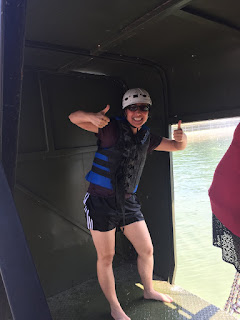 |
| I've been rescued! |
We spent so much time at the Aviation Challenge that we had to scarf down lunch in order to make it to our Alpha Mission. For this simulation, the space shuttle orbiter Atlantis had to go to the ISS and switch out the crew. My job was solely on the ISS - I was a Flight Engineer I, which means I had to go on an EVA (ExtraVehicular Activity)... a spacewalk. Beth and I had to go out in space suits and built a structure outside, while sitting in neutral gravity seats. In the meantime, other people had jobs in Mission Control (MOCR - Mission Operations Control Room) and in the orbiter.

At first, Beth and I had to give ourselves a physical exam - we took our temperatures, blood pressure, and pulse. Then we got ready for our EVA. The space suits were really bulky and difficult to wear - first, we put on some "long underwear" - large pants with suspenders. On top of that we had vests with ice packs - really necessary because it gets HOT inside the suit, but heavy and unwieldy. The jacket goes over it all and zipped up in the back. On our head is a headset under our helmets, and we have moon boots and gloves that impede fine motor control.
 |
| I'm ready to go! |
 |
| Beth and I, on our EVA. |
Putting together the structure outside was actually pretty difficult, since the materials we were using were old (so the screws were stripped and wouldn't stay in place) and the gloves made it hard to manipulate the screws. We were seated on low gravity chairs (which balance our body weight using water tanks), so we had to hook our feet onto the metal structure to keep ourselves from floating away or bumping into each other. On top of that, we had several mishaps and equipment failures, including our radios cutting in and out (and Beth's never working) and my suspenders (which weren't properly tightened so they slipped down to my elbow, preventing me from lifting my arm). Even so, it was so much fun being out there and getting to wear and work in the space suits.
 |
| The Apache Helicopter gunner and pilot |
After the mission, our crew trainer Cristy was nice and gave us an hour and a half of free time to explore the museum, grounds, and gift shop. We started by going outside to ride the Space Shot, which shot us up to simulate a launch and to give a moment of weightlessness. It was over 90° outside so we didn't want to stay out too long, so we went back into the museum. We spent most of the time waiting in line and doing the Apache Helicopter attack simulation (which was like a really glitchy video game, but fun sitting in the helicopter).
Our next job was training for the Bravo Mission, which we'll be doing the next day. This time I'm the CAPCOM officer, meaning I'm in charge of communications with the capsule. I stay in mission command center, this time on the Moon at the Shackleton Operations Command Room, or SOCR. This job requires a lot of talking and switching from channel to channel (talking with SOCR and the Orion) plus problem solving all anomalies (system failures that pop up in the capsule), so I definitely won't be bored!
We had dinner, and to round out a busy day we ended with the 1/6 gravity chair, which simulates walking on the moon. It's like the world's slowest trampoline, but lots of fun!!
 |
| I'm on the moon!! (cue Baywatch slo-mo running music...) |
SUNDAY
It was a much more relaxing day, even though we accomplished a ton. Team Destiny started the day with sessions by the Honeywell Ambassador teachers. First was a talk by Seema, a teacher from India who has done so much at her school integrating sustainability practices, ecology education and space education. It definitely sounds like she has amazing support from her administration, and her kids are well funded and high-functioning, but nonetheless she inspired all of us. We also heard from Vanessa, who showed us how to bring kids to Space Camp (not really relevant for me, but fun to watch).

We then went to launch the rockets that we'd built a few days ago. There is a large field where we ignite the engines (little gunpowder capsules), and in turn we set them off to see if they would work. Each rocket has three parts, with a parachute stuffed in the bottom, and our team had several spectacular failures. Mine went off fine, but I gave it to Karen, whose rocket ended up in the trees.
 |
OLE 1, PROP, and CAPCOM,
hard at work |
We had a long leisurely lunch, followed by our Bravo Mission - this time, it was set in the year 2041 and we were based on the moon inside the Shackleton Crater. Our goal was to send the Orion shuttle to the Rising Star station to fix damage done by an asteroid. My job was inside the SOCR - as the CAPCOM officer in charge of communications with everyone inside the Orion capsule. I was constantly switching channels on my headset from A (hearing what was going on at SOCR), to B (hearing the Orion crew).
 |
| My SOCR workstation |
It was actually hard and stressful, because there was a very strict timeline and script that we needed to follow, but there were anomalies thrown in that I had to solve and direct the Orion crew to fix. On top of that, the scripts weren't well written and had several mistakes, and we weren't confident enough to do a lot of improvising. Even so, we successfully landed the Orion and had a great time.
 |
| Team Destiny, hard at work |
*** Commercial break for nerds ***
Cristy gave us another chunk of time to wander, and this time some of us returned to the Davidson Center (Saturn V Hall) and talked to another retired NASA alumnus. Again, we heard some amazing stories about his time working on the Apollo, Gemini, and Space Shuttle missions. He told us about Skylab (and how the arm holding the solar panels got stuck, so the commander had to hammer it loose and was flung out into space by the spring loaded arm... luckily, he was tethered in, so he yo-yo'd a few times before reeling himself back on board), and about the space debris from the Sat V Apollo 12 stage 4 rocket, which was supposed to use moon's gravity to get flung into space but instead got stuck in orbit around the sun... then fell into the Lagrange point (the point between two bodies where gravity is basically the same) between the Earth and the Sun so it got pulled into Earth's orbit. It is now projected to fall back into the lagrange point and will most likely get sucked back into the Sun's orbit in the future. In case you're wondering, you can read more about it
here.
*** Back to our regular programming ***
 |
| Taking external egg temp every 30 seconds |
We ended the evening with another design challenge - creating an ablative heat shield that would protect our 'egg'stronaut during a 5- minute atmospheric reentry (a blowtorch). My team - Hermelina, Josh, Jodie, and Lauren - used aluminum foil, cork, steel wool, and other materials to make a successful shield. It actually kept the egg at the coolest temperature of any team - it went from a starting outside temp of 88° to an end temp of 112°. Some other teams actually cooked their eggs, and got up to temperatures in the mid- and upper- 200s.
That night we had fun watching Top Gun, with Josh and Lauren wearing their flight suits throughout the entire movie...
MONDAY
Our last day of camp was bittersweet - even though we've only been together for 5 days, Team Destiny became close friends quickly, and we'll miss being together nonstop. The morning started out fairly relaxing, learning about camp opportunities for visually impaired students and other special needs groups. Then we watched the IMAX movie Journey to Space, which was especially fun since there were several people who had never seen a domed IMAX screen before.
 |
| Working on our rover |
We then moved on to our next design challenge - the X-Prize. This challenge is modeled after Google's $20 million challenge of landing a rover on the moon - we were to land our 'egg'stronaut rover safely on a lander inside a hula hoop target, then remove the rover and roll it down a ramp for as long a distance as possible. Our lander was the only one that made it into the hoop, and the rover had the second-best distance.
We also made paper rockets that were launched by blowing on a straw - each rocket had different variables that we were supposed to test to see what worked best. Mine, which was weighted at the nose cone, flew the farthest.
 |
| Homer Hickham Jr, Rocket Boy |
The guest speaker for the afternoon was Homer Hickham Jr, author of Rocket Boys and the inspiration for the movie October Sky. He had a great story about overcoming obstacles, and was kind enough to give us each a personalized autographed copy of his book.
 |
| Our Commander's Cup patch! |
That evening was graduation, which made us officially Space Camp Alumni. Unbeknownst to us, we'd been graded during all our missions and design challenges, and surprisingly, Team Destiny won the Commander's Cup for having the best score for our challenges. We were given mission patches for our flight suits.

The graduation dinner was held in the Sat V Hall, and it's amazing to think that a group dinner of over 100 people can have a sitdown dinner (including a band and dance floor) under the nose cone of a Saturn V rocket, and still only take up 1/4 of the room...!
The evening ended with music and dancing - a great way to end a great week. We leave Huntsville tomorrow, and I'm really going to miss the camaraderie we built with Team Destiny and the rest of the Space Camp crew. Thanks again, Honeywell, for such an incredible experience, and thank you to everyone at the US Space and Rocket Center and Space Camp.


 After watching the bear for a while, Jeanne and I decided to go down to bed around 11:30PM. I was
getting ready to close the porthole when I glanced outside, and to my surprise
the bears were right outside the window. In a stroke of luck and perfect timing, just then the mother was startled and
ran right across our field of view. Because we were down in our rooms, we got a
great eye-level view. We could easily see the look of urgency in the mother’s face,
and the curiosity and confusion in the eyes of the cubs. Turns out the solitary male had made his way over to the ship, and would potentially kill the cubs. Luckily, this one was more interested in us than the other bears, and spent some time circling the ship before wandering away.
After watching the bear for a while, Jeanne and I decided to go down to bed around 11:30PM. I was
getting ready to close the porthole when I glanced outside, and to my surprise
the bears were right outside the window. In a stroke of luck and perfect timing, just then the mother was startled and
ran right across our field of view. Because we were down in our rooms, we got a
great eye-level view. We could easily see the look of urgency in the mother’s face,
and the curiosity and confusion in the eyes of the cubs. Turns out the solitary male had made his way over to the ship, and would potentially kill the cubs. Luckily, this one was more interested in us than the other bears, and spent some time circling the ship before wandering away.


 After watching the bear for a while, Jeanne and I decided to go down to bed around 11:30PM. I was
getting ready to close the porthole when I glanced outside, and to my surprise
the bears were right outside the window. In a stroke of luck and perfect timing, just then the mother was startled and
ran right across our field of view. Because we were down in our rooms, we got a
great eye-level view. We could easily see the look of urgency in the mother’s face,
and the curiosity and confusion in the eyes of the cubs. Turns out the solitary male had made his way over to the ship, and would potentially kill the cubs. Luckily, this one was more interested in us than the other bears, and spent some time circling the ship before wandering away.
After watching the bear for a while, Jeanne and I decided to go down to bed around 11:30PM. I was
getting ready to close the porthole when I glanced outside, and to my surprise
the bears were right outside the window. In a stroke of luck and perfect timing, just then the mother was startled and
ran right across our field of view. Because we were down in our rooms, we got a
great eye-level view. We could easily see the look of urgency in the mother’s face,
and the curiosity and confusion in the eyes of the cubs. Turns out the solitary male had made his way over to the ship, and would potentially kill the cubs. Luckily, this one was more interested in us than the other bears, and spent some time circling the ship before wandering away.