THURSDAY, June 19 - Neuschwanstein & Lindau
As one of the most iconic and beautiful landmarks in the world (and Disney's inspiration for the Sleeping Beauty castle), I had to stop for a visit to Neuschwanstein, the fairy-tale castle built by King Ludwig II of Bavaria.
* * * * * * * * * * * * * * * * * * * * * * * * * * * *
Brief History Break – The Mad King
King Ludwig II of Bavaria was crowned at the age of 18 in 1864. He was shy and artistic, spending much of his time and energies on lavish building projects. As a patron (and huge fan) of composer Richard Wagner, he had many of the walls of Neuschwanstein decorated with scenes from the operas Tristan und Isolde, Tannhäuser, Lohengrin, Parsifal, and others. Aside from Neuschwanstein, he also built the equally ornate Linderhof Palace and Herrenchiemsee complex; Linderhof was the only residence that was finished in his lifetime. Because of his extravagance, he was declared mentally ill, and was deposed on 12 June 1886. The next day, he and his doctor were found dead on the shores of Lake Starnberg. The circumstances around his death are still a mystery.
* * * * * * * * * * * * * * * * * * * * * * * * * * * *
 |
| Hohenschwangau Castle and Alpsee Lake |
Neuschwanstein sits in the foothills of the Alps above a narrow gorge near the Alpsee Lake, across from the Hohenschwangau Castle where Ludwig II spent much of his childhood. Ludwig was always fascinated by medieval legends, romance, and architecture. He commissioned Neuschwanstein as a private retreat and was extremely hands-on in the design and decorating. It was also fitted with the latest innovations such as warm running water, flushing toilets, central heating, and telephone lines.

Unfortunately, only about 15 rooms/halls were completed before Ludwig's untimely death; Ludwig lived in it for just 172 days. Even thought King Ludwig never wanted the palace to be accessible to the public, Prince-Regent Luitpold ordered it open to paying visitors just 6 weeks after Ludwig's death. Using the funds, construction debts could be paid off and the building could be completed with a much simpler plan.
The castle itself is not large, but the rooms we saw were lavish and fanciful. Many themed rooms were inspired by myths, legends, music, and especially Wagner's operas. The Byzantine Throne Hall was particularly impressive, with animal mosaics on the floor, large murals of the apostles, holy kings, and knights adorning the walls, and a huge, 13-foot tall chandelier made to resemble a crown. And the sumptuous Singer's Hall, with paintings of the Knight Parzival and his son the Swan Knight, was so intricately detailed that it was impossible to take in everything.
 |
| Singer's Hall and Throne Room, photos by Joseph Albert in 1886. It still looks the same! |
 |
| Neuschwanstein from Marienbrücke |
 |
| Marienbrücke from Neuschwanstein |
After my tour, I hiked back over to the Marienbrücke, or Mary's Bridge, for the famous view of Neuschwanstein. Even though it was extremely crowded and touristy, this iron footbridge truly gives a magical and enchanting view of the castle.
 |
| The Lion and Lighthouse, at the entrance of Lindau Harbor |
I then stopped in the Museum of Bavarian Kings to learn a bit about the history of Bavaria, then set off to Lindau to meet with my friend Nick, a fellow Nat Geo Explorer who is working in Germany. Lindau Insel is the Old Town (Altstadt) on a small island in eastern Lake Constance (Bodensee). From the biergarten where we hung out, we could see across the lake to three countries - Germany, Austria, and Switzerland. We could also see, in the distance, the Austrian and Swiss Alps. We relaxed by the waterfront, then wandered around the town. It was a lovely and relaxing way to end the day!
 |
| The colorful houses of Lindau |
 |
| Wir möchten eis! |
FRIDAY, June 20 - Lech and St Anton am Arlberg
Driving between countries in the EU is really easy these days; in fact, sometimes you have to be careful that you don't accidentally end up somewhere you shouldn't be (only because you have to pay for rental car insurance for each individual country, and I only planned to be in Germany and Austria. Where we were near Lake Constance, it would have been easy to get to Austria, Liechtenstein, and Switzerland, and the French border was just a couple hours away.) Because of this, Nick and I decided to explore the Austrian Alps. After a quick breakfast in front of the Neptune statue in the Lindau Insel Marktplatz, we set off into the mountains.
 |
| The view of Lech, from the Rüfikopf gondola |
Many of the Alpine ski towns continue operations in the summer as hiking and mountain biking destinations. Ski gondolas continue to run, allowing visitors to enjoy the views from high above. We got some bread and cheese to bring along, and made it just in time for the 10 minute Rüfikopf cable car ride to the peaks of the Arlberg region above Lech. The top station sits at an altitude of 7,700 ft (2350 m), and snow still covered some areas in patches.
 |
| Fossilized mussels paint the rocks |
There is a small but surprising geology exhibit, featuring fossilized mussels and squid that show how 200 million years ago, this area was once underwater. From the lodge at the top, there are a number of hiking trails that go all over the mountains, but we spent most of the time enjoying the views and looking at the surprisingly vast array of wildflowers.
 |
| Finding the perfect picnic spot! |
 |
| Wildflowers abound in the Alps |
I was so lucky to be with Nick, an ecologist who studies pollinators and plants, and who shared his passion for all the amazing wildflowers that we saw. There are so many cool details if you take the time to look! Did you know that the petals on a buttercup's flowers are shiny? They use the glean from their petals to attract bees from afar (as opposed to their color, which attracts pollinators from a closer distance). Nick also taught me about hermaphroditic flowers, who separate their male and female parts either through space or through time so that they don't self-pollinate.
 |
| Flowers flowers flowers everywhere! |
We examined the Alpine Forget-me-nots, the delicate little blue flower with the yellow or white ring at the base of the petals. We saw how older flowers had white or pale rings, while the younger flowers had yellow rings, so Nick thought maybe it was a sign of whether the flower was male or female. And did you know: there are many different species of bees, but their defining characteristic that makes a bee a bee is that the entire food source of a bee comes from flowers.
 |
| Fascinating forget-me-nots |
After a snack of tea and Apfelstrudel at the restaurant overlooking the valley, we headed back down to Lech and continued through the mountains exploring the ski towns. We tried stopping for dinner in Zürs, which was a surreal (and a bit creepy) experience. Along with Lech am Arlberg, Zürs is one of the most renown ski resorts in the Alps, boasting many (mostly luxury) hotels.
 |
| The eerie and ominous Zürs |
But in the summer season, Zürs is like a ghost town. It was obvious there were people somewhere in town, since the windowboxes of flowers seemed well-maintained and a handful of cars were scattered around, but we didn't see any people and all the hotels were shut down and restaurants were closed. It had the aura of the Shining but in opposite, where instead of an isolated winter hotel, Zürs was a desolate summer resort. It was the perfect setting for a horror movie!
So instead of staying and becoming a victim in the next zombie apocalypse, we continued down to St. Anton am Arlberg, where we found an inexpensive hotel nestled on the hill among a group of posh hotels. It was a lovely little village nestled in a valley with beautiful mountain views. We walked into town for dinner, then had an early night.
SATURDAY, June 21 - Silvretta and Oberammergau
 |
| Stopping for a picnic snack |
After breakfast, we headed to the Silvretta-Bielerhöhe High Alpine Road - a beautiful and popular mountain road that took us to the Silvretta reservoir. Here it truly felt like we were in the Alps - huge craggy peaks loomed in the near distance, and flower-filled meadows hosted herds of what must be the happiest cows - each with a tinkling cowbell that was much more mellifluous than the tin-can clank that I normally associate with cowbells. There are colorful wildflowers in bloom all over, giving pops of color to the lush green fields.
 |
| Silvrettasee, with views of Egghorn and Schattenspitz Glacier |
We walked across the dam and through the light tunnel art installation, but unfortunately the rest of the path - as well as the rest of the High Alpine Road - was closed because of construction due to a rockfall from last year.
 |
| Through the light tunnel! |
We had to turn back and drive the way we came, but since the scenery was spectacular and the roads were easy to navigate, it was a pleasant trip over to Feldkirch where Nick was catching a train. Thanks, Nick, for a fun few days in Austria!!
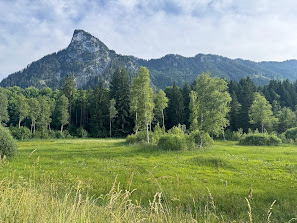 |
| Kofel Mountain, guarding Oberammergau |
After dropping Nick off, I headed back into Germany and over to the storybook village of Oberammergau in the Bavarian Alps. It is mainly known for three things: the woodcarving tradition that came from the abundant forests that surround it; the colorfully painted buildings that give it its charm, and the world renown Passion Play.
* * * * * * * * * * * * * * * * * * * * * * * * * * * *
Brief History Break – The Oberammergau Passion Play
This picturesque town is best known for its once-in-a-decade production of the Passion Play. According to legend, the play was first put on in 1634 as a vow to God in exchange for sparing the town from the bubonic plague. Since no other villager died after the vow was made, the village continued their promise of performing the suffering, death, and resurrection of Christ.
The production involves nearly half of the town's residents - to participate, you have to have been born in Oberammergau, married a local, or lived in the village at least 20 years. Over 2,000 residents take part as actors, musicians, and technical support. The year before production, the town has a "hair and beard decree" banning haircuts and shaves, so that no wigs are used. These days, the Oberammergau Passion Play is known worldwide, with famous guests in attendance - including Franz Lizst in 1870, Thomas Cook in 1880, Queen Isabelle II of Spain in 1890, Gustave Eiffel in 1900, William Howard Taft in 1910, Henry Ford in 1920, William Randolf Hearst and Adolf Hitler in 1934 (for the 300th anniversary special show), Dwight Eisenhower and Konrad Adenauer in 1950, Cardinal Ratzinger (Pope Benedict XVI) in 1980, Angela Merkel in 2010, and Ian McKellen in 2022. It is now performed in every year ending with a '0' (except for a few delays/cancellations, such as WWI, WWII, and COVID). The next play, in the year 2030, will be the 43 staging of this 5+ hour extravaganza.
* * * * * * * * * * * * * * * * * * * * * * * * * * * *
 |
| The Hansel & Gretel Haus |
Oberammergau is a visual treat because of the multitude of buildings that feature Lüftlmalerei, a type of mural art that adorns many homes and businesses. These colorful frescoes are quickly painted onto wet plaster, before it dries in open air (air = "Luft" in German). In fact, the painting style may be named after Zum Lüftl, the Oberammergau house of the famous Lüftlmalerei painter Franz Zwinck. The town isn't large, so walking around and finding these buildings was an easy and pleasant way to spend the afternoon.
 |
| Detail from the Hansel & Gretel Haus |
Many of these paintings feature Biblical or mythical/fairy tale stories, or scenes from everyday peasant life. Well known buildings include the Hansel & Gretel Haus (which was once an orphanage, and now still houses youth welfare services) and the Red Riding Hood Haus.
 |
| Das Rotkäppchenhaus (Little Red Riding Hood House) |
Perhaps the most famous example of Lüftlmalerei is the House of Pontius Pilate (painted by the famous Lüftlmaler Franz Seraph Zwink in 1784). In it, the front door is flanked by curved staircases leading up to a rounded portico that is held up by columns. In the scene, Pontius Pilate sits on a throne with Jesus Christ at his feet.
 |
| Pontius Pilate's House |
SUNDAY, June 22 - Partnachklamm, Leutaschklamm, and Ettal
I spent the day exploring the spectacular nature of the area. My first stop was to Partnachklamm, a deep gorge carved by the Partnach river near the town of Garmisch-Partenkirchen.
A walkway runs along the side of the 260 ft deep gorge, with the torrent of clear, turquoise water rushing alongside. It is a narrow, slippery path with several tunnels and overhangs carved into the rock - in some places, it was so dark I had to use my phone flashlight. I arrived early enough that there were very few people on the path with me and I basically had the trail to myself. I decided to backtrack through the gorge to experience it again (instead of taking the longer path through the mountains around it) and there were a lot more people coming through. It was about a 20 minute walk from the gorge to the parking area - the lot near the Olympic Ski Jump stadium, built for the 1936 Winter Olympics.
 |
| Walking through the Olympic Stadium to get to the parking lot |
Just a half hour away, on the border between Germany and Austria, is another fascinating gorge - Leutaschklamm - also known as the Leutasch Ghost Gorge, so named for the legends of ghosts and goblins that live at the bottom of the canyon. It is accessed from both countries, but I went from the Austrian side and enjoyed the many signs telling stories about the goblins.
 |
| How cool is this slow worm?!? SO COOL! |
While walking through the forest on the way to the gorge, I saw a slow worm - a type of legless lizard that looks like a snake!
The spectacular thing about this experience is that the trail follows the gorge along metal walkways that cling high on the walls of the cliffs. Far below is the Leutascher Ache river, which carved the gorge. The walkway also crosses the gorge on a 75 meter (~250 ft) high panoramic bridge, giving an amazing view of the Leutascher Ache river far below. From the bridge we could also see the Wetterstein Mountain.
 |
| The Panorama Bridge |
It was great going to both gorgeous (haha) gorges, especially since they gave such different perspectives - one from above and the other from the level of the river. And given they are fairly short hikes and very close together, it was easy to do both in one morning!
 |
| ... and dang impressive inside! |
With plenty of time left in the day, I decided to stop by the small village of Ettal - known for its 14th century Benedictine monastery. Ettal Abbey is famous for running the Ettaler Klosterbiere - the Ettal Brewery, established in 1609.
 |
| That's a big basilica for a small village! |
Most tourists come here for the beer, but I just enjoyed visiting the giant Baroque basilica. I also enjoyed a leisurely Bavarian lunch before heading back to Oberammergau.
MONDAY, June 23 - Linderhof Palace
 |
| Linderhof from the Music Pavilion |
On my final day in Germany, I visited the palace and grounds of Linderhof, the complex built by "Mad" King Ludwig II. Inspired by the French Sun King Louis XIV, Ludwig had this elaborately designed schloss built in the elaborate rococo style similar to Versailles. Even though the palace is relatively small, it still had over-the-top details like a table in the private dining room that lowered down to the kitchens on a disappearing platform so that it could be laden with food, then raised up so that the King wouldn't have to deal with servers.
 |
| Just his lil ol haus... |
But my favorite part of the visit was seeing the various outer buildings scattered throughout the park. The most outrageously excessive was the Venus Grotto, the stalactite cave that Ludwig built as a private space where he could enjoy his favorite Richard Wagner operas.
 |
We couldn't take photos of the palace or grotto, but
here's one from their website |
The grotto was meant to mimic act I of Wagner's opera Tannhäuser, and includes an artificial lake, waterfall, and wave machine. I got lucky as the grotto had just reopened after an extensive reconstruction project closed it for 10 years.
All around the grounds are several interesting structures. My favorite was the Hunding's Hut, a simple wooden house from the outside, but modeled on the inside to resemble the character Hunding's dwelling from Act I of The Valkyrie (from Wagner's Ring Cycle).
 |
| Hunding's hut set design, 1876 |
 |
| Hunding's Hut |
Inside is a huge (fake) ash tree from which Siegmund pulled the sword Nothung.
Also on the grounds are the Moorish Kiosk, built for the 1867 International Exhibition in Paris and featuring a magnificently jeweled Peacock Throne; the Moroccan House, built in Morocco for the 1873 International Exhibition in Vienna; and the Temple of Venus, a Greek Temple at the top of a series of terraced gardens looking down to the main palace.
 |
| The Peacock Throne |
 |
| Moorish Kiosk |
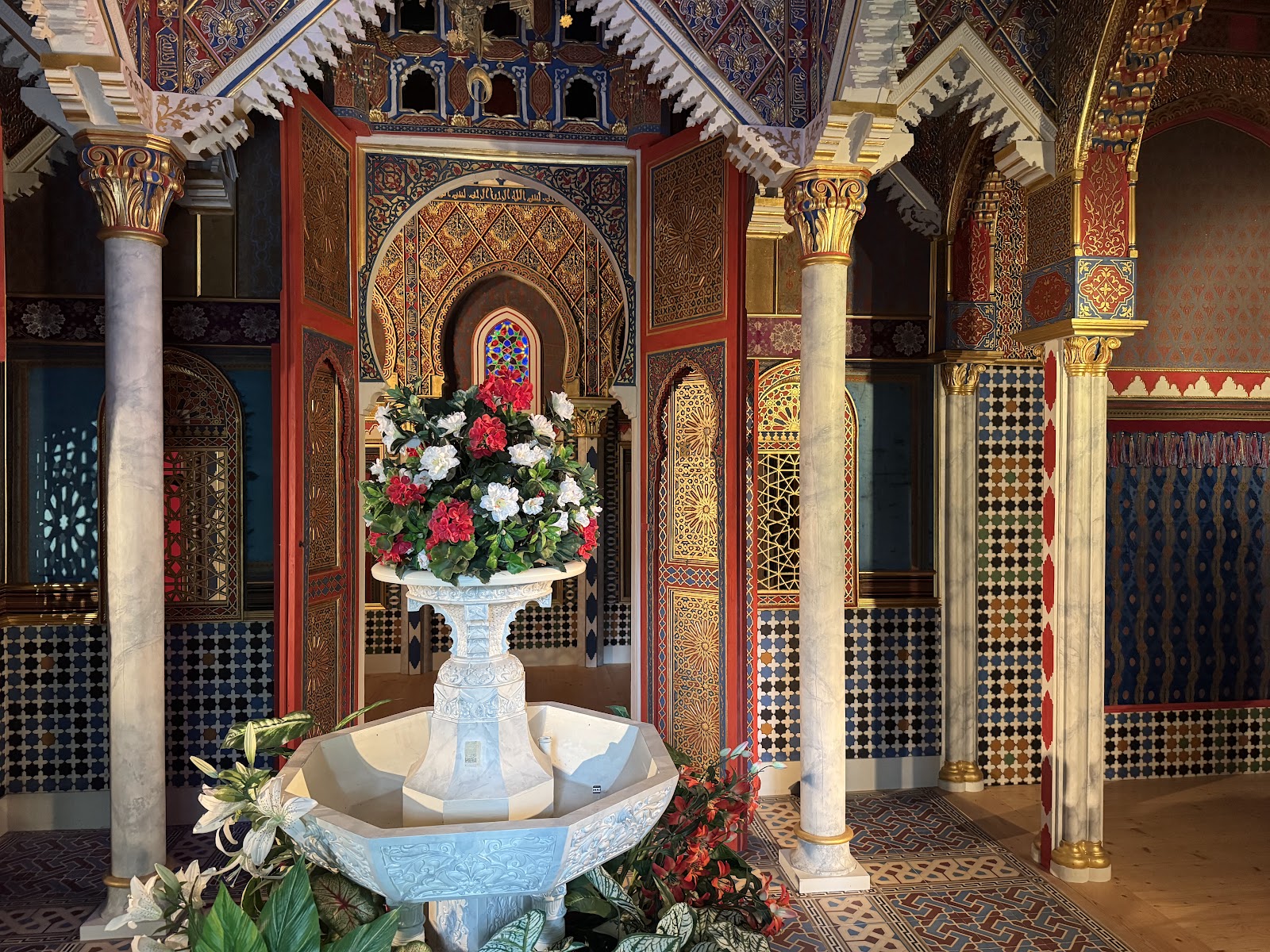 |
| Moroccan House |
Walking around the grounds really allows you to immerse yourself in nature. The mountains rise up around you, and the park is so large and wooded that you can easily isolate yourself - for much of my walk, I was alone and couldn't see or hear any sign of civilization. It was easy to see how the reclusive King Ludwig could find solitude here; but his fanciful and artistic side could also be fulfilled.
 |
| The isolated woods at Linderhof |
Overall, my visit to Germany was a fascinating mix of fairy-tale fantasy, modern progress, natural wonders, and disturbing history. Thank you to Atlantik Brücke for this amazing opportunity; thanks to Franka and Philipp for your leadership, hospitality, and friendship; and thank you to my fellow teachers for an unforgettable experience! Germany was wunderbar!


