TUESDAY
A long, long travel day (getting up at 4:30AM) and catching two flights, from Pune to Bangalore, then on to Madurai. Madurai is the heart of rural Indian culture, located in the state of Tamil Nadu. It has the population of a city but the heart and culture of a village. It is by far the most rural city that we've visited, with a smaller 'feel' and a warmer and friendlier vibe.
That evening, we went to the Chella Meenakshi Center for Education Research and Services for a briefing, presentation, and dinner. Just as we finished our registration process, we went outside for a dance performance. As we were waiting, we could hear the drumming of rain to our right. And as the first dance, one calling for rain, began, so did the monsoon. Torrents of rain came down, drenching the performers and most of us sitting in the audience. Even so, it was a wonderful performance. We saw several folk and traditional dances, done by men, women, and children. After the dance we had a dinner of traditional Southern Indian food.

 WEDNESDAY
An early morning yoga session began our day, although most of the time was spent with a yoga lecture, explaining the original purpose of yoga (to help with meditation and thought control) and naturopathy. We did two rounds of the sun salutation, but since it was so warm and humid in the hotel, we were sweaty by the end of it.

Soon after, those of us that wanted to went to visit the Vidyalaya Jain school. It ended up being a great visit - we had a question and answer session with the teachers, who were very interested in how schools in the US deal with many of the same issues and problems that Indian teachers face. The school treated us like dignitaries, giving us a warm welcome, giving flowers, and serving a nice breakfast. At the front of the school, they had created a mandala in the dirt - something done during special occasions or when honored guests come. They sat us in front of the audience and introduced each of us individually. We didn't have time to visit any classrooms, but did see the kindergarten area before rushing off to our next meeting.
 |
| The Jain School Q&A session |

The rest of the group met us at the ASSEFA milk processing plant, which showed the other side of the milk collective that helps rural women gain empowerment and funds. We saw how milk was collected, tested, pasteurized, and packaged - it comes from villages within a 25 km radius, and is sold in a 100 km area.
 |
| The Gandhi Museum |
We then set off to the Gandhi museum, where we learned the kolattam - ritual stick dance that in the past was only performed by males. After lunch, we toured the Gandhi museum, and saw the sari that he was wearing when he was assassinated.
We then toured the Lions Aravind Institute of Community Ophthalmology (LAICO) eye hospital, where they have perfected large-quantity low-cost cataract surgeries. Their goal is to get rid of all unnecessary blindness, and they have done an excellent job serving the masses. Touring the hospital was a bit uncomfortable, as their methods are SO different from our hospitals (there are no privacy regulations, sanitation doesn't seem very good, and there doesn't seem to be any concern for the patient experience,) but as the director explained, Indians have a very different expectation.
 |
| Our banana buffet |
For tea, we had a 'banana sampling', where we had a choice of several different types of bananas to try. Kara, Brittany, and I shared 5 different varieties - all were delicious, and tasted very different from each other.
Late return back to the hotel for a quick dinner, then bed since our days here in Madurai are packed!
THURSDAY

Today was another full but great day. We spent the morning at the Meenakshi Amman Temple, a huge Hindu temple complex dedicated to Meenakshi and Shiva. It was supposedly built in the 6th century BC, although the current temple was built in the 16th century. Meenakshi Temple is unusual for a Hindu temple, because the main deity is not the God but the Goddess.
There are 14 gateway towers around the complex, the largest being the southern tower at 170 ft high. Each on is built in the Mughal architectural style, with Italian stucco as the basis for the decorations. And the decorations are elaborate. There are over 30,000 sculptures all around the temple, but the most notable part is the vibrant colors that they are painted. And the figures seem small when you look at the gates from afar, but they can actually be around 6 ft tall.

We spent some time wandering around the inside (the inner sanctum is closed to non-Hindus, but the rest can be seen). It is so big that many of the corridors are filled with market stalls, and we did spend some time shopping.


Right after lunch a hardy few of us went back to the Gandhi museum conference room for another dance lesson - this one a folk dance that traditionally was done by men, but now is done by both men and women. We did our best, although it was hot in the room and we were all so full from lunch.

After a quick shower, we set off again to the music college where we watched a classical Indian concert, with flute, sitar, veena, tabla, and drum.

Dinner was southern Indian food again, at the college, and again eating with our hands. Delicious, but a lot of food!
FRIDAY


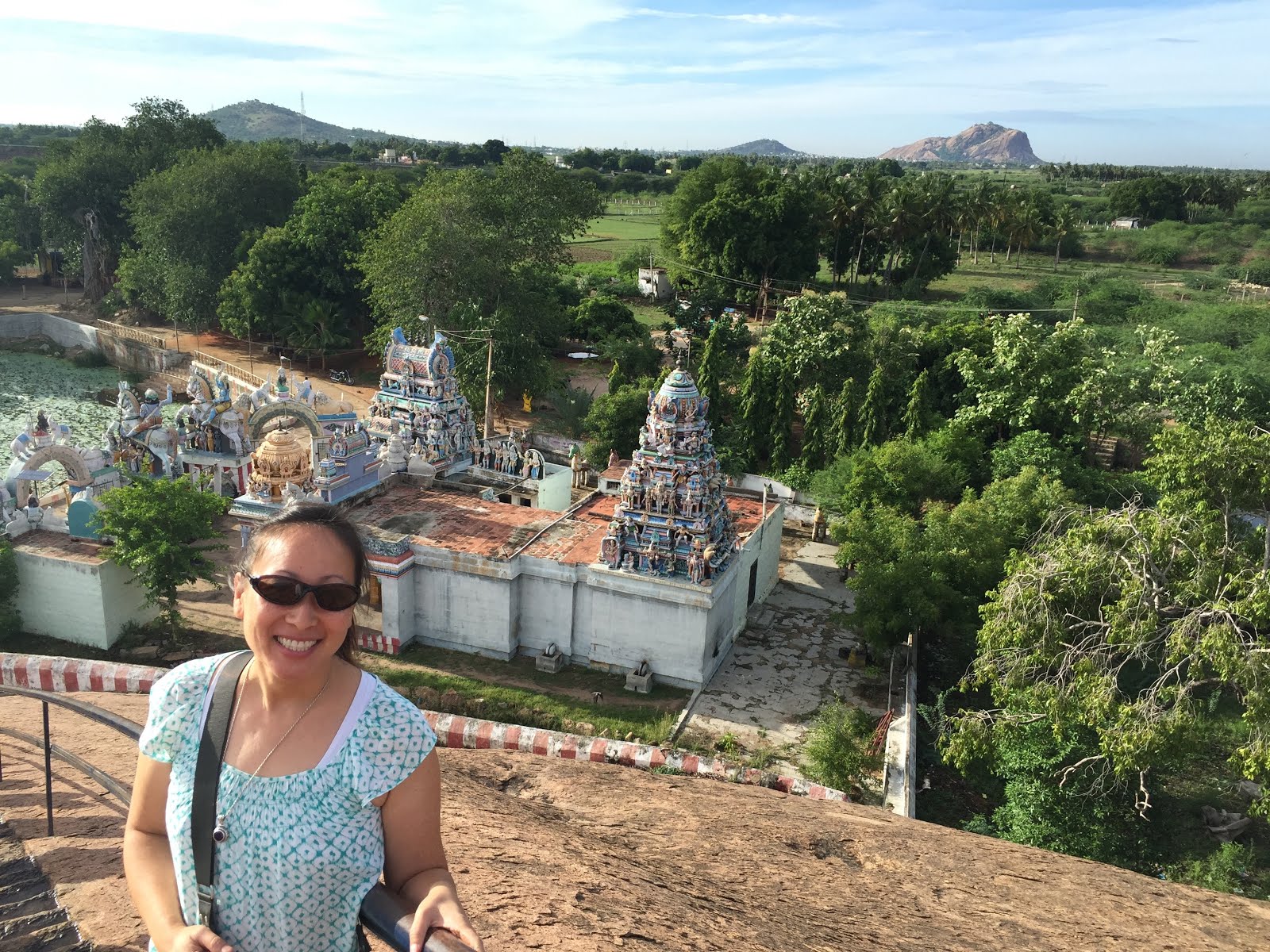
An early morning start brought us outside the city, to the Jain caves - an archaeological site in a nearby village called Keelakyuilkudi. This area is sacred because it holds many sacred Dravidian objects - Snake Hill, a holy banyan tree, a perennial pond, and a mountain that can be circumambulated in a day. We climbed up the hill to view the carvings, and Dr. Vidya gave us a 'sermon on the mount' - a lecture about Jain religion in Southern India. From the top of the mountain, we had a great view of the lush surrounding agricultural region.


At the bottom of the mountain is a Jain cave, which back in the day was a stop along the old trading routes. We had our breakfast by the cave, and viewed the carvings in the cave walls.

From there, we traveled to the Covenant Centre for Development (CCD), an NGO that promotes agriculture based sustainable livelihoods to help women, the landless and small farmers, and backwards tribes. We met in a hot and stuffy school room, and unfortunately we were all so tired and hot that it was difficult to concentrate. We did get to walk around the area, seeing the harvesting of medicinal plants and the packaging of herbal remedies.

Lunch was outside, and it was nice getting a view of the pastoral land. We ate at a long thin table with a view directly into the fields, so it was truly a 'farm to table' meal.
In the afternoon, we drove to the Pamayan farm in Tirumangalam. The farm is a model of organic, self-sustaining farming practices, and he has solar power and a small stepwell to collect rainwater. While we were waiting for our lecture to start, a foot-long lizard fell out of the ceiling and directly onto my lap! I think I was a bit too shocked to do anything, and he fell onto the ground and scampered away.
 |
Each crescent-shaped lake is part of the interconnected tank system,
coming out of the Vaigai River that runs directly through Madurai. |
We had a lecture on the watershed of the Madurai area, which manages its water resources by creating a system of tanks (which are more like large ponds) connected to each other by canals. These come from the river that flows directly through Madurai, and divert them into successively smaller tanks in the outlying areas. People can access the water only when the final, furthest tank is full, and that tank is reserved specifically for religious purposes. This method allows everyone in the area to have access to water, and to make the most out of the rainfall and watershed of the region.

For dinner we drove back to Madurai to the CM center, where we had another delicious dinner. It was a loooong day, but full of great information!
Overall, it has been an wonderful but overwhelming few days... this is the India we were hoping for!
SATURDAY
 |
| Madurai Seed staff and volunteers |
Today was a day of optional activities, but of course I had to try it all!! We started the morning with a visit to Madurai Seed, an NGO that serves the slum community called Karumbalai. They work to develop young people by offering workshops, tutoring sessions, camps, and seminars in order to give them the educational support that their families can't give them. All of their students are first-generation college bound, but last year 100% of their graduates went on to college. And 95% of their staff are volunteers, mostly former Madurai Seed students who return to give back to the community.
 |
| With the children of the Karumbalai slums |
To get to Madurai Seed's office, we first walked through the neighborhood through the small streets. Everyone we met was friendly and welcoming, smiling and waving as we walked by. And like many Indians that we've met, they all wanted their picture taken - even though it was on our cameras and they wouldn't get a copy of the picture! As we walked down the street, children started following us, calling out their hellos.
 |
| Stall on the edge of the old market |
After our visit, we stopped by the old market across from Meenakshi Temple to get in some shopping. The market used to be the only place in Madurai where people shopped (this is back in the old days), and it definitely retains its old-school crowded, narrow-aisled feel. Some stalls were even candle-lit, because it seemed as though the power was out some areas. And it was interesting seeing a market in this very old, dark area - with elaborate columns and carvings, and statues of gods and goddesses lining the walls.
 |
| Pomegranate seller |
 |
| Gettin' my mehendi on |
We then went to the CM center for the rest of the day, to participate in the "At Home" sessions put on by the CM staff. There were chances to get Mehendi, dances, food, cooking lessons, garland making lessons, and lessons on kolam (sand art, made every morning in front of each doorway to welcome guests and set the tone for the day).
 |
| Learning kolam |
 |
Stacey and I, with garlands (that we
didn't make - it was too hard!) |
We got back to the hotel just in time for our goodbye dinner by the pool, then set out at 9:30PM for a walking tour through the old Madurai business district. This area is perpetually busy - trucks are not allowed into the city after 7PM, so all the unloading of goods happens at night and much of the trading goes on 24-hours.
 |
| Arun, the king of spices. His picture is everywhere in the market! |
 |
| Fruit seller |
 |
| Garlic and ginger stall |
We ended our walk at 11PM, but the lorry load men and women hadn't even started working yet! Nonetheless, it was still a bustling area - Madurai truly is the 'city that never sleeps'!

 Following lunch, Eric, Abbey, Mark, Mario, and I decided to go tea tasting and shopping. We squeezed ourselves into a cab and rode out to the tea shop that Eric heard about. The first place had a ridiculously long line, so we walked down the street to a smaller store and did our shopping. We all bought the assam masala, then tried their darjeeling (which is supposedly what everyone in Bengal drinks). I bought a more expensive kind - supposedly a good quality, but then we stopped at the first shop and had REALLY expensive darjeeling. Of course, as tourists we were probably completely ripped off, but nonetheless we bought ourselves a small sampler for a taste test. Both stores were happy to give us a cup of their darjeeling, which was flavorful but we all thought was brewed longer than we would have liked.
 Our final day in Kolkata started with a visit to a local ('peri-urban') village just outside the city. SAFE, the South Asian Forum for the Environment, is working with locals to provide safe drinking water access, as well as creating a recycling project to turn former landfill paper into artisan crafts. The water initiative uses solar power to run their filtration system, and each family is given an RFID card to access 10 L of water. If their usage goes over 300L in a month, they are charged a fee which helps with the upkeep of the system. The filtration system filters about 60% of the water into drinking water; the remaining 40% is used for their sanitation system - ie, their toilets. It's a brilliant, sustainable system that is helping all of the families (about 540) in the local area.
 We were basically frozen, uncomfortable and unsure of ourselves, when a nun came over to talk to us. Sister Inez is originally from Poland, and has worked in India for 4 years. Prior to coming here, she was in Iceland and England, and she says in all the places she's been, nothing compares to poverty in India. Poverty in Poland is nothing like poverty in India, she says, and Iceland? Not even close.


 Following lunch, Eric, Abbey, Mark, Mario, and I decided to go tea tasting and shopping. We squeezed ourselves into a cab and rode out to the tea shop that Eric heard about. The first place had a ridiculously long line, so we walked down the street to a smaller store and did our shopping. We all bought the assam masala, then tried their darjeeling (which is supposedly what everyone in Bengal drinks). I bought a more expensive kind - supposedly a good quality, but then we stopped at the first shop and had REALLY expensive darjeeling. Of course, as tourists we were probably completely ripped off, but nonetheless we bought ourselves a small sampler for a taste test. Both stores were happy to give us a cup of their darjeeling, which was flavorful but we all thought was brewed longer than we would have liked.

 Our final day in Kolkata started with a visit to a local ('peri-urban') village just outside the city. SAFE, the South Asian Forum for the Environment, is working with locals to provide safe drinking water access, as well as creating a recycling project to turn former landfill paper into artisan crafts. The water initiative uses solar power to run their filtration system, and each family is given an RFID card to access 10 L of water. If their usage goes over 300L in a month, they are charged a fee which helps with the upkeep of the system. The filtration system filters about 60% of the water into drinking water; the remaining 40% is used for their sanitation system - ie, their toilets. It's a brilliant, sustainable system that is helping all of the families (about 540) in the local area.


 We were basically frozen, uncomfortable and unsure of ourselves, when a nun came over to talk to us. Sister Inez is originally from Poland, and has worked in India for 4 years. Prior to coming here, she was in Iceland and England, and she says in all the places she's been, nothing compares to poverty in India. Poverty in Poland is nothing like poverty in India, she says, and Iceland? Not even close.