Saturday, July 30, 2011

Durban

July 29 - Durban
Holy smokes I'm tired. Got up at 4AM this morning to catch a flight to Durban. It was grey and rainy when we got here - very unusually cold, so they say. We immediately went to the Toyota factory for a tour of the production facilities. It was actually really interesting - we went around the factory floor, from the stamping machine (where they formed the parts for the doors and body from sheets of metal), to the assembly and welding area (where we were showered with sparks from the welders), to the finished product, where they started up the engine for the first time. Interestingly, they don't make the cars in like batches - there is a white, right hand drive car, then a blue left hand drive, etc. Doesn't seem efficient to me...

Had lunch at the factory, then went to the Bisasar Road Landfill. It's where they have a gas-to-electric project, extracting and burning off methane and other gasses and generating electricity. It was raining when we got there, so it was a quick visit.

After that, we had a talk with the Environmental Planning and Climate Protection Department of the city of Durban. They discussed the challenges of environmental protection when weighed against other urban needs, such as the housing shortage. We also went to see the living roof pilot project at the nearby department building.

It was a lot of info, especially since we were all so tired from the long day. Had dinner at the restaurant around the corner - tried the Portuguese sardines, which were pretty good, and had a steak. Lots of meat here! Everyone is off to bed early tonight...

July 30 - Durban
A great day today! Packed and a bit rushed, but lots of good stuff. Had breakfast at the hotel and left early - 8AM - for the Toyota facility to meet with the South African teachers. They are in the Toyota Teach Program, which identifies at risk schools and provides a mentoring program for the teachers. We talked to several of the mentors and got a good overview of the South African schooling system.

After that, we went to the Buffelsdraai Landfill, an area where they are trying to reforest with indigenous plants as a way to offset the carbon emissions from the World Cup (and, to some extent, the upcoming COP 17 Conference). They get their trees form local "tree-preneurs" who trade saplings for basic goods like food, clothing, and school fees. This way, the local people have a tie to the project and the land.

From the landfill, we went into the community to see one of the tree-preneurs. We had to walk about 5-10 minutes up the hill to a house. Along the way we waved at many people, and then we just started talking to them - to kids on the street and women outside their houses. They were all so welcome and friendly, and wanted to show us their homes. One woman, Pel, took us down to see the view behind her house. On the way back to the bus, two 7th graders took Uzma and I to see their planted trees. It was a fabulous experience talking to the locals and we didn't have nearly enough time.

Proud tree-preneurs 
The view from our actual seats...
Then I schooled Eric on the art of
sweet-talk, and got us onto the field...
We left around 2 for lunch, at a bird park, then off to Mr Price Kings Stadium for the Sharks vs. Cheetah's rugby match. It was so much fun! Eric and I decided to try sneaking on the field, so we went down and played the dumb tourist "we're from the US and have never seen rugby and can we just take a quick photo?"  Believe it or not, it worked. We basically stayed more than half the game, in the front row at center field.

...which gave us a slightly better view of the action!
Plus, you get to interact with
TRUE rugby fans!
The rugby players are HUGE - I can't believe they aren't all on steroids - and the hits are VERY hard. Can't say we understood what was going on, but it was still exciting to see the action and viscerally feel each hit and tackle! I can't imagine being this close to an American football game, so I wish I knew more about rugby. Nevertheless, it was an unforgettable experience.

The sharks won, 40-29, and after the game I bought two Springbok Jerseys (I know, not Sharks, but the Nation'l team of South Africa).


Came back to the hotel - we were going to walk to the beach but the receptionist said it was very dangerous (as did Jameson) so Elaine and I came back. met up with a group for dinner - fish and chips, a local (Capetown) fish called Kingklip. It's Deb's birthday today, and surprisingly JL paid for all of our dinner on Toyota's dime!
Tomorrow, off to Cape Town!


Thursday, July 28, 2011

Soweto

July 28 - Soweto
Today we went into Soweto - the SOuthWEsternTOwnships of Johannesburg where displaced South African Blacks were forced to move during Apartheid. The most moving thing for me was the hope and joy of the people. In my visions of Soweto, I always saw miles of shantytowns - poverty and dispair beyond belief. But I was amazed by the people we saw - those on the streets who waved and smiled to the busses, the vendors who were friendly and open, even if you didn't buy anything, the people working in the restaurants and museums and churches. Given their history and past circumstances, the Sowetans had and have every right to feel bitter and to complain about their lot in life. Instead, I saw genuine joy and smiles, and a peoples who strive to overcome those obstacles and despite everything, to enjoy life.
We started the day at Freedom Square in Kliptown. The monument celebrates the rights of the people, and the "X" on the top of the monument represents the voting rights of the people.

From there we drove through Soweto, stopping to see some of the "informal settlements" that still sprawl across the landscape. It was a difficult thing to see from inside our luxury busses, and it was our first real taste of the poverty and plight of the people.

We drove to the Regina Mundi Church, where Bishop Desmond Tutu and the Truth and Reconciliation Committee met, as well as where all of the funerals from the Soweto Uprisings were held. Unlike those glorified, gothic monstrosities you see in Italy and other parts of Europe, it is a humble brick building with cracked tile floors, worn carpeting, and bullet holes in the roof. Upstairs is a series of photos from Soweto's history, and graffiti jams the walls behind the pictures. The struggle of Soweto's people clearly impacted everyone one on earth, and the messages left there show how inspirational they were.

From there, we went to the Hector Pieterson memorial and museum, a tribute to the young who marched in the Soweto uprising and who gave their lives for the struggle against apartheid.

Then to the Nelson Mandela House: 


And on the way, we saw the cooling towers from the power plants that were used to generate electricity for the whites in Joburg.


Wednesday, July 27, 2011

Johannesburg and Pretoria


An early start this morning - we almost missed it because the alarm was turned so low the neither Candice nor I heard it! So we got up at 7:30 for a 7:45 meeting - had a quick bite for breakfast then met at the hotel with our South African guides. First we heard from Keira, our tour guide from Spirit of Africa, who gave us a Quick History of South Africa from the Beginning of Time Until the Present. (Well, maybe her title was different, but that's what it should have been.) She had some really interesting insights on the background of whites in ZA, including the conflict between Boers and the English that led up to Apartheid. We also heard from Mark and Sphesh, guides from Educo Africa, a group that takes disadvantaged youth on wilderness adventures (a program that sounds a lot like Outward Bound). They're here to help us process and understand the things we're about to see.

We then left for Pretoria (the Executive capital of ZA) to visit the US Embassy. The roads here are very nice - for the World Cup last year, they widened the highway so there was virtually no traffic. Many big businesses and offices in modern buildings lined the highway - not what I expected of Africa. But this is Northern Joburg and Pretoria, where the biggest boom of economic development is happening on the continent, so I'm sure it isn't representative.


The US Embassy is a concrete, sterile building where we couldn't take pictures of bring any electronic equipment. We heard from the Minister Counselor of Public Affairs (Karl Stoltz), who gave an overview of US interest in South Africa (which deals in large part on educational and health reform). Also heard from Fulbright specialist Mareka Chabedi who discussed ZA's education system, and Martin Matlebyare, an economics
specialist who talked about ZA's environmental sustainability.

After leaving the embassy, we went to the Union Building Gardens for a picnic lunch. The Union Building is theExecutive house of the government, where the President has an office. Its also where Nelson Mandela was sworn in as president in 1994. There are beautiful tiered gardens with a great view of Pretoria.


After lunch, we drove back to Joburg to the Apartheid Museum. Along the way, we saw the stadium where the World Cup opening and closing ceremonies were held. The Apartheid Museum opened in 2001 and is a really stark but beautiful building. I especially loved the pillars reading "Freedom", "Respect", etc.

The museum gave a history of apartheid in ZA and showed many photos, videos, and articles. Not sure if it was because I'd just gone to the Holocaust Museum, but I didn't find it nearly as depressing as I was expecting. (Although I admit to getting emotional watching the video of FW de Klerk's speech when he freed Nelson Mandela).

Had dinner at Gramadoelas Restaurant, in the
old market building. It was an interesting restaurant with great decor, serving all kinds of traditional African foods. Tried fried mopane worms and ostrich, among other things. Delicious!


Now we're back at the hotel, and I'm trying to warm up. It is reaaallly cold here, unusually so, and they say it's the coldest day they've had this year. Supposedly there is a cold front that is only going to last a few days. But in the meantime, Welcome to Winter!

Tuesday, July 26, 2011

Start of the African Journey

So I finally made it to African soil! So far the trip has been wonderful - the people at Toyota and IIE are fantastic, and the teachers on the trip are all great - nice, friendly, and a very accomplished group. They treat us very well, so we're going to be spoiled by the time the trip ends!!

I left San Jose on Saturday night, 8PM. It was an eerily empty airport - actually kind of creeped me out, horror movie-style. But I connected smoothly in LA and had an easy (is this possible?) red-eye out to Washington DC. Met up with Candice at the airport and we took a limo to the Capitol Hill Liaison hotel - right near the Capitol building. It was around 8AM when we checked in (and 90 degrees - eesh!) and they didn't have a room ready yet, so after changing, Candice and I decided to walk around the mall. We ended up going to the Holocaust Museum, since neither of us had been there before.
The museum is dedicated almost entirely to the Holocaust, and is really good but very disturbing. It discusses several aspects leading up to the war, gives various perspectives, and has pictures and case studies. After a while it got to be a bit too much for both of us and we had to walk fairly quickly through the whole second half. I think the most disturbing part was the room of shoes - the musty, leathery old smell was really haunting.

From there, we walked to the Museum of American History and had lunch - then we just went back to the hotel to rest. After a nap and shower, we met up with the rest of the TITP group for the welcome and intros. Along with the 24 teachers, there are two IIE staff (MarDestinee and Mike), 2 from Toyota (Rhonda and her boss JL), 2 videographers (Dave and Scott), and a journalist (Osha).


At 6:30, we walked over to the US Botanical Garden for a reception - it's a beautiful space, and we met several other Toyota and IIE staff, plus a number of people from the South African Embassy.

It was lovely event, sponsored by Donald Payne, the congressman from NJ, who came to speak to us. Too bad I was so dang tired - by then I was totally exhausted.

The next morning, we checked out at 7:45 and went to the Toyota DC office for breakfast.
We ate up on their rooftop deck, which had a nice view of the city and Washington Monument. Then we went down into the offices for a talk about Toyota's environmental initiatives, plus a South Africa overview given by the Deputy Chief of Mission from the ZA embassy.

Lunch was on our own, paid for by the stipend they gave us at the beginning of the trip. It was raining pretty hard (but still very warm and muggy) so we went around the corner for a quick lunch then hid in the Toyota building until it was time to go. At 2, we headed out to the airport, checked in as a group, and waited through the 2 hr delay (ugh!).

It was a 7 1/2 hour flight to Dakar, Senegal, an hour or so wait on the plane, a disgusto anti-bug spray, then another 7 1/2 hours to Johannesburg. But we finally made it!

Now we're in the Grayston in Sandton - a very nice hotel in the fancy part of Joburg. We're all completely exhausted... off to bed...

Tuesday, August 10, 2010

Ecuador Part III: The Amazon

I'm in El Oriente, the Ecuadorian side of the Amazon Rainforest.

Wow.

On Monday morning, I got picked up at 6AM and rode the bus down to Shell. That sucked. In Shell, we split up into three small planes for the 50 minute flight into the rainforest. Basically, we followed the Pastaza river almost to Peru, over giant swaths of green, onto a dirt and mud runway in the middle of the jungle.

Welcome to Kapawi!
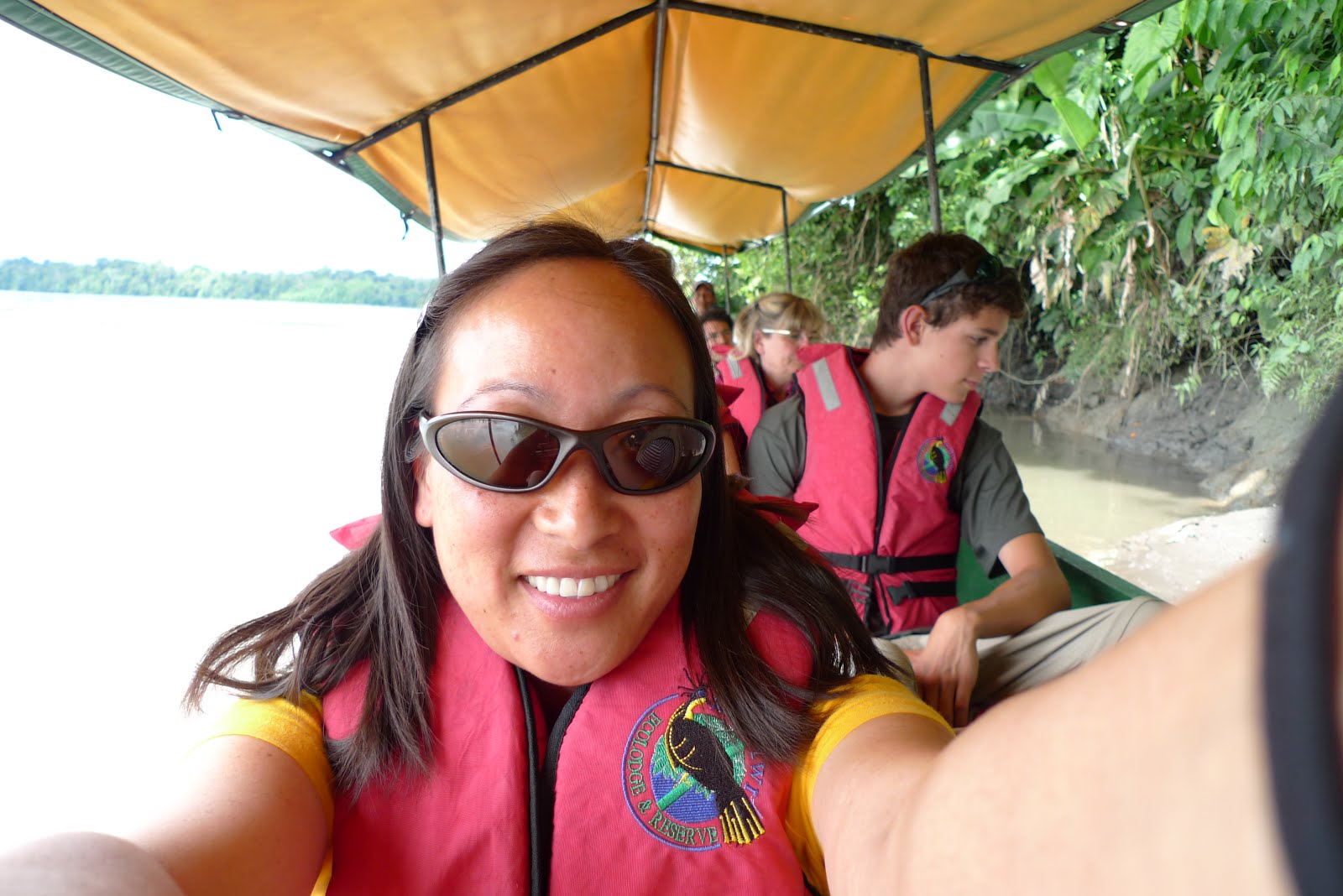
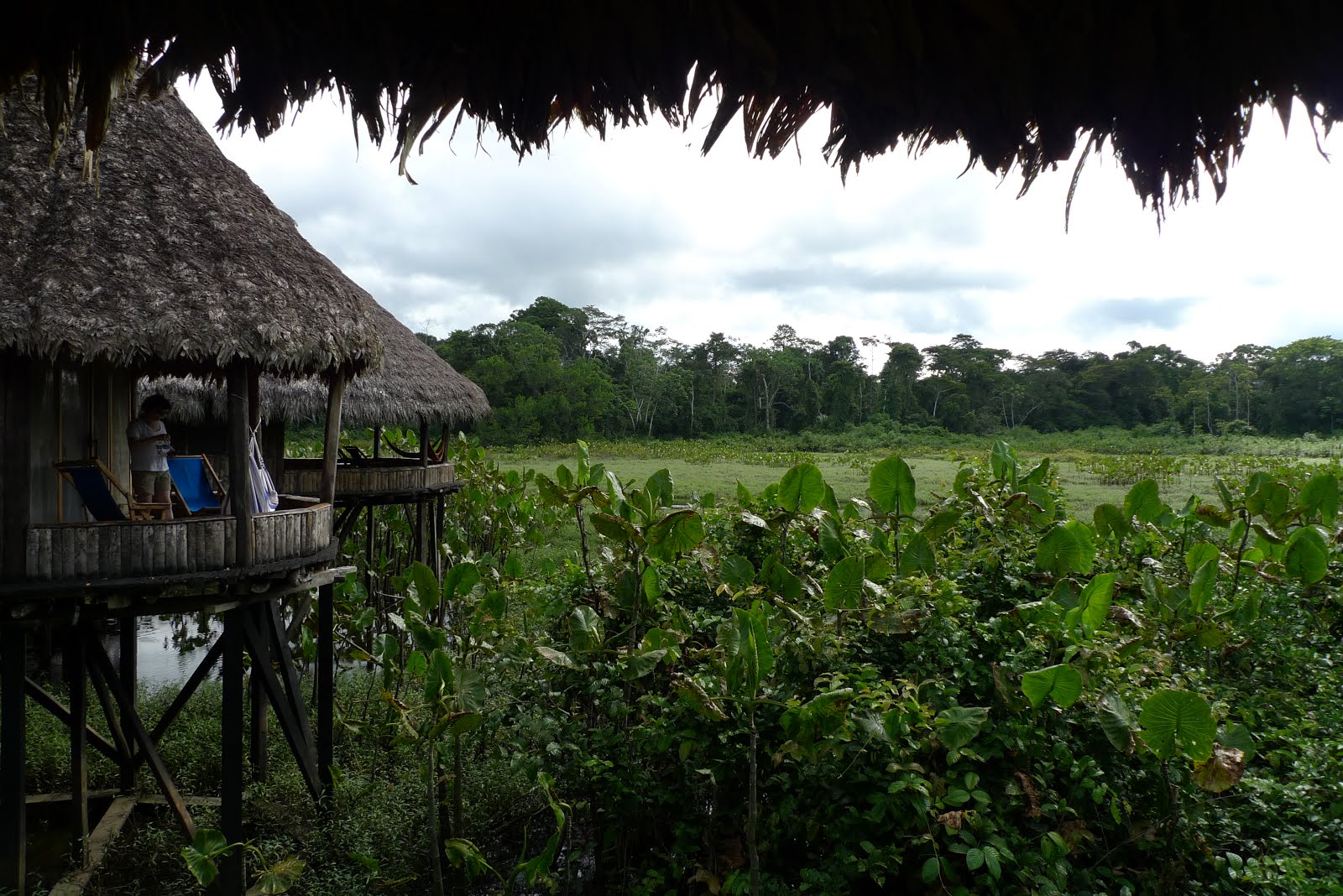
From there, we took a canoe ride of about an hour up the Pastaza to the Capahuara River, where the Kapawi Lodge is located. There are wooden boardwalks everywhere, and our rooms are individual huts on stilts that jut out overlooking a peaceful a lagoon. The boardwalk is wet and slick, and there's no way I'd touch the railings because some bug or another is hiding in every nook and cranny. Heck, some aren't even bothering to hide... This is not the place for the bug-phobic.

The view from my porch
We started with lunch in the main dining hall, then a rest for the afternoon - a good thing, because I was so tired and still feeling a bit woozy from my ears. I feel asleep on my porch. It's quite warm here, even when it rains, and especially when its sunny. Plus, it's super humid (which always makes me drowsy).


The rooms are dark and made of palm, with screen windows with no glass so there are plenty of bugs in the rooms. At least there is a mosquito net, so sleeping is comfortable. No hot water though - we get a solar camp shower every day (but the temperature depends on if there is sun) and it is delivered around 5PM so if you want warm water you have to shower right away.


We met at 7 to break into our groups - mine is Joey, Sarah, and Dave, a nice family from Pennsylvania who talk a LOT - and a Turkish couple. There is also a Canadian mom and daughter, and two German couples, but they are in the other group. After dinner we went on a night boat ride - trying to find caimans, but we only glimpsed one before it slipped into the water. But we did see a night bird, and for a while they turned off all the lights and motors and we just listened to the sounds of the jungle - very cool.

In the morning, wakeup is at 6AM - someone comes to knock on our door. Had some tea, then at 6:30 we had a birdwatching boat ride. Saw a yellow headed vulture, many banded toucans, and several macaws, parrots, and parakeets. Also saw some pink dolphins!


Breakfast was a 7:30, with the first hike at 9:30. We went on the Capahuara Pastaza Trail - took the canoe up the Capahuara and hiked 2.5 hours to the Pastaza. Learned about medicinal plants, which was interesting - 90% of whats in the jungle is toxic, but they figured out the things that were medicinal. Things like Devil Finger fungus, which cures earaches, a tree whose bark is an anaesthetic, etc.
Can you spot the dusky titi monkey?


There he is!


Having a professional guide is absolutely critical - I'm constantly amazed by what they can find in the jungle!!


DON'T TOUCH ANYTHING!!!

Hiking in the jungle is interesting - our warning at the start was: Don't touch ANYTHING because lots of things can sting you, bite you, or hurt you! So its kind of nervewracking, since the jungle is pretty dense and leaves brush against you all the time.

We have two guides, Jose (an Achuar guide who only speaks Spanish), and Carlos. Jose leads, carrying a machete and hacking down vines and leaves as he goes.


Jose showed us a 'false bullet ant' - a huge, almost 2 inch long ant that resembles the bullet ant, which gives one of the most painful bites in the insect world (Carlos says it hurts for 3 days).
Also saw a monkey stair vine, a cool twisty vine whose legend we'll hear tomorrow.

Back to the lodge for lunch and a rest (again, I was exhausted so I fell asleep) and in the afternoon the activity was kayaking. We went in a canoe up the Pastaza and floated back down to the lodge. It was nice and we saw a woodpecker, but I was with Sarah and they wouldn't stop talking.
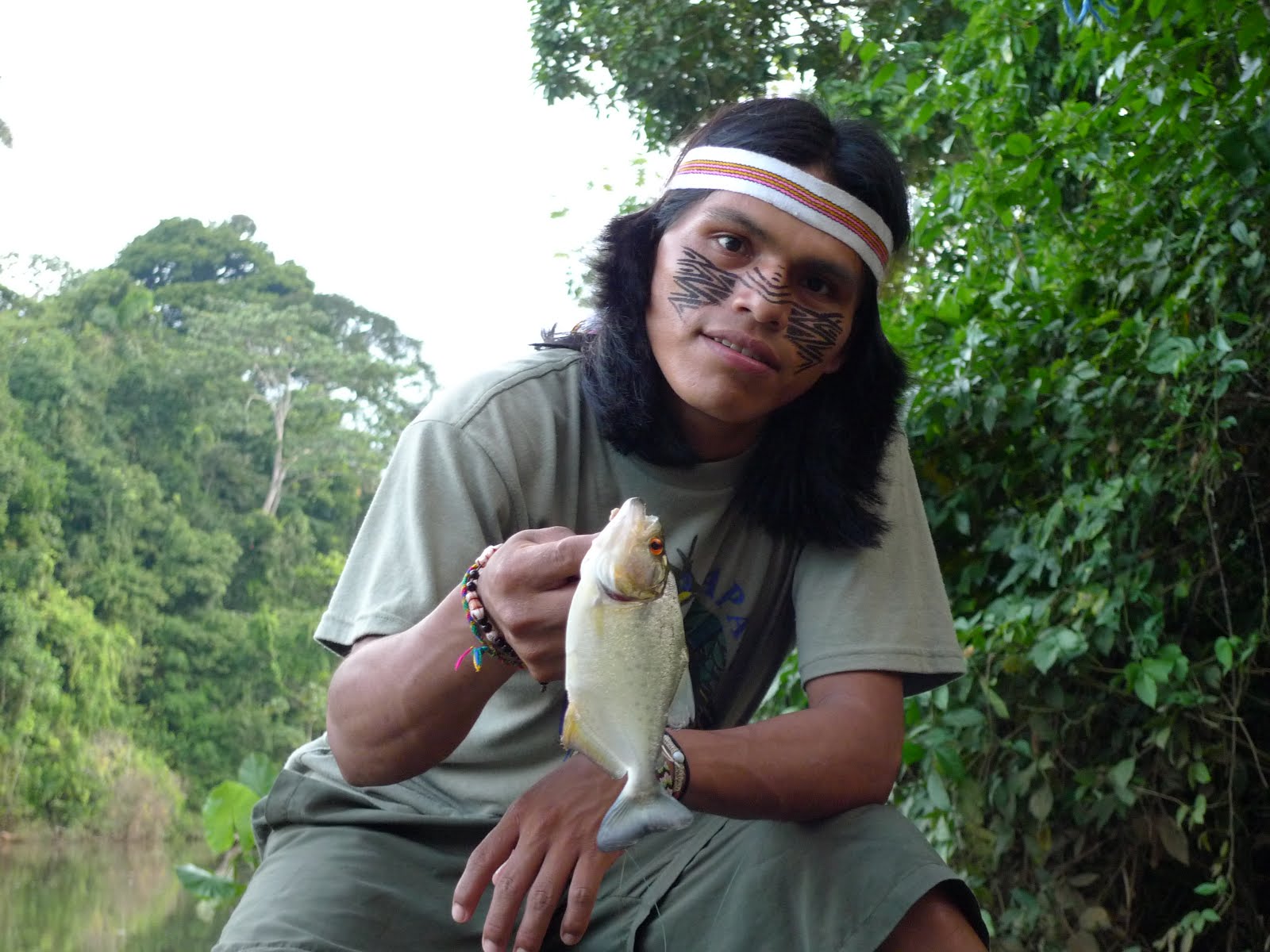
We went fishing, and the only person who caught anything was,
of course, Jose. But he caught a piranha!
It started raining when we got back - I had a shower and rested until the dinner horn at 7:30, and since it was raining they cancelled the night insect hike. Nice to get a little extra rest, though.
Mornings on the Amazon are beautiful!


Wake up, little owl!
This morning I got up at 6 and sadly there were a bunch of moths in my bathroom because I left the light on. Not making that mistake again! Had some tea and then went on the birdwatching boat ride again. This time, I saw more variety - owls, kingfishers, turkeys, etc. And more pink dolphins, which was cool.
Pink dolphins always look sunburned...


After breakfast, we went by canoe for the next hike, the Lobo Trail, from up the Capahuara back to camp. On all hikes we have to wear big rubber boots because of the mud - hot, but helpful.

On the way up the river, we saw some red howler monkeys from a distance, plus some smaller dusky titi monkeys up close. And many other birds plus some river turtles.
Fresh jaguar tracks


The acme spring trap...


This hike was supposed to be about palm trees - the different uses and types. It started raining early into the hike, but it wasn't too bad. Jose showed us how to weave palm fronds to make the roofs, how to get the fiber for string, and how to set traps.


Saw a bullet ant nest, plus part of a dead snake - very red with black stripes. Also saw a monkey from afar, toucans (Many Banded Aracari and White Throated Toucan), and a very colorful grasshopper. So much biodiversity out here - it's truly amazing!
Gorgeous patterns on this guy
Masked crimson tanager


To finish the day, we went on a night hike - mainly to see insects. All I can say is... wow. Saw the most amazing prehistoric scorpion spider - Carlos called it a whip spider - with grabbing claws in the front and a stinging tail. So freaky! It had rained all during dinner so it was pretty wet, and the bugs were everywhere. Saw a centipede - poisonous! - the difference is that millipedes have two sets of legs on each body segment, and centipedes have one.

I would NOT want this crawling on me...
He was humongous!

There were tons of crickets, grasshoppers, beetles, spiders, moths, and stick bugs. I liked the happyface spider - with a yellow body and black markings that really do look like a happy face. Saw a huge bullfrog - the size of a baseball mitt as well as a smaller toad-looking frog. All of us turned off our flashlights for a little while and it is SO dark in the jungle!! We all decided if you got lost out there with no flashlight, that's it. Totally DEAD, no question about it.
it... was... HUGE...
Leafcutter ants


Today was another cool day - in the AM, birdwatching was at the Kapawi High School, which was interesting to see. We got there a little late so there weren't too many birds, but we did see a horned screamer, which are not that common.

The high school was for most of the Achuar community - they come from afar to attend, and can come even into their 20s to learn English. There are fairly basic facilities - raised classrooms with no windows. They try to get volunteers in to teach English.

The classroom
After birdwatching, we went back to the lodge for breakfast, then went on Pitzacocha lagoon for the final hike. Jose talked about the spirit of the forest, as well as hallucinogens that the Achuar use to get in touch with the spirits. At the beginning of the hike we saw a tayra - a black monkey-like animal that Carlos says is related to an otter.
Sunning in the Pitzacocha Lagoon

Saw a huge tree with buttress roots, and at the lagoon saw turtles and horned screamer, hoatzin, and herons. There were a couple log bridges to cross, which was a bit scary in the rubber boots because it was hard to get any traction.


Hoatzin

Tasting lemon ants - yes, they did
taste like lemons!


At the end of the hike we had lunch at some tables in the forest and a canoe met us - it was really good for a picnic! - rice and a beef stew (kind of stroganoff) and salad, and even dessert of canned peaches.


From there we went to the Wachirpas Village, near the airstrip, where Jose lives. There were no photos allowed, because it was their home. The village seems pretty rundown - there is garbage on the ground and chickens running around. Houses are open huts with raised platforms that serv as beds. Clothes are hung on a string - that's their closet. Houses are divided into 2 parts - masculine, where guests can go, and feminine, which is the kitchen/sleeping area that is for family only. We visited a shaman's house - first we went in and said hello - "wi nìa jai". Sat and the chief of house's wife served us chicha in small bowls. Chicha is fermented manioc (yucca). Women chew it up and spit it back into the pot - they made it while we were there and it was kind of disturbing listening to them spit (fairly loudly and with very full mouths.) Three women were doing it, all into the same pot. The enzymes from their saliva is breaks down the starch into simple sugars, and it ferments to flavor the drink. Each batch of chicha tastes slightly different, depending on who made it. We talked to the Shaman for a while (1.5 hours or so, with Jose translating Spanish to Achuar). Then we looked at and bought their handicrafts. I bought 3 bowls, 3 necklaces, and a bracelet.

Study Break (ie, break to study)
Achuar vocabulary
Hello: Winiajai (we-NYA-hai)
Thank you: Maketai (mah-KET-tay)
Goodbye: Weajai (we-YA-hi)

Back to Kapawi for the goodbye dinner - traditional food - soup with chicken and yucca, plus manna - food wrapped in leaves and put in the fire - we had piranha with heart of palm. That night there was storytelling by the fire - interesting, but a lot was in Spanish which I didn't understand. The two main stories were how man got fire - a hummingbird was saved by the family that owned fire, and it was warming up and it's tail caught on fire, and when the man opened the door to check on the fire the bird flew out with it - and that's how fire got out. It's also why the Achuar respect hummingbirds.

The second story was about a man and woman - the woman ate all the vegetables, so to be punished, he went up and climbed a monkey ladder to get away from her and turned into the moon. And she became a bird that cries only during the full moon.

This morning, we got up at 6 for birdwatching - saw some dusky titi monkeys in a tree in the lagoon. After breakfast, Jose showed us first where the red dye for facepainting comes from - a fruit off a tree in camp, with weird seeds that have a red coating. 

Then he showed us how to use a blow gun - they are quite long and made with palm tree. Dart tips are cut into barbs with piranha teeth and tipped with curare, which paralyzes/poisons the monkey or bird. We tried blowing the blow gun but it's really really hard!

We were late leaving camp because the plane was delayed (of course! As usual, as Carlos says) but we made it about an hour or so late - not too bad. At the airstrip there were several kids playing. Some boys were playing marbles right on the runway. Made it back to Quito around 6:30 - and back to civilization.

I can honestly say I was completely blown away by my time in the Amazon. Perhaps more so than the Galapagos - the biodiversity found in the rainforest is astounding, and there was so much to see and learn everywhere you look. It's easy to see why this area is thought of as the lungs of the earth, and it's also easy to feel a connection and desire to keep it safe.

Bye, Amazon! You are amazing!

Partial list of animals we spotted
Many banded Aracari (toucan)
White throated toucan
Amazon kingfisher
Speckled Chachalaca (turkey-looking thing)
Yellow headed vulture
Plumbeous kite
Chestnut fronted macaw
White eyed parakeet
Dusky headed parakeet
Yellow crowned amazon (parrot)
Social flycatcher
Oropendola
Hoatzin
Black caracara
Horned screamer
Laughing falcon
Yellow rumped cacique
Spix's guan
Tropical kingbird
Ring kingfisher
Magpie tanager
Night Jar
Striated heron
Amazon river dolphin
Caiman
Red Howler monkey
Dusky titi monkey
Tayra