Thursday, April 7, 2022

Amazonia, part 3: In the jungle, the mighty jungle...

Our time in Amazonia was spent in Madre de Dios, a region of southeastern Peru in an area known as the Tambopata National Reserve - near the western border of the Amazon Basin. What causes such a vast rainforest to form here? On the western side of South America, the Andes mountains block moist air coming from the east, causing a huge amount of rainfall. This moisture slowly flows eastward across the entire continent, seeping from marshes to stream, then to tributaries that feed into the Amazon River, which eventually reaches the Atlantic Ocean. 

The Amazon rainforest, or Amazonia, covers an area of 2.3 million square miles (in comparison, the continental US is about 3 million sq mi). While most of it is in Brazil, about 13% is in Peru (as well as parts in Colombia, Bolivia, Ecuador, French Guiana, Guyana, Surinam, and Venezuela). This dense tropical forest is the world's largest rainforest, sometimes thought of as the 'lungs of the world', and definitely a hotspot for biodiversity. 

Tambopata is famous for birds - more specifically, the macaws and parrots that come to the clay licks in search of minerals they need. But I was initially introduced to Tambopata by an entomologist, and my previous trip to the Amazon showed me how diverse (... and profuse!!) the insects are in the rainforest. And I never knew how interesting the flora could be, but exploring with a forest ecologist whose passion for every fern, orchid, and vine really made me appreciate the plant life - not to mention the mushrooms and molds that we encountered!! Being here is completely overwhelming... but exhilarating!

We were spending 9 days in Madre de Dios, and each day we had multiple forays into the rainforest. We were hiking 7-10 miles, usually on two or three outings each day, with some boat rides interspersed. 

Stairmaster, schmairmaster
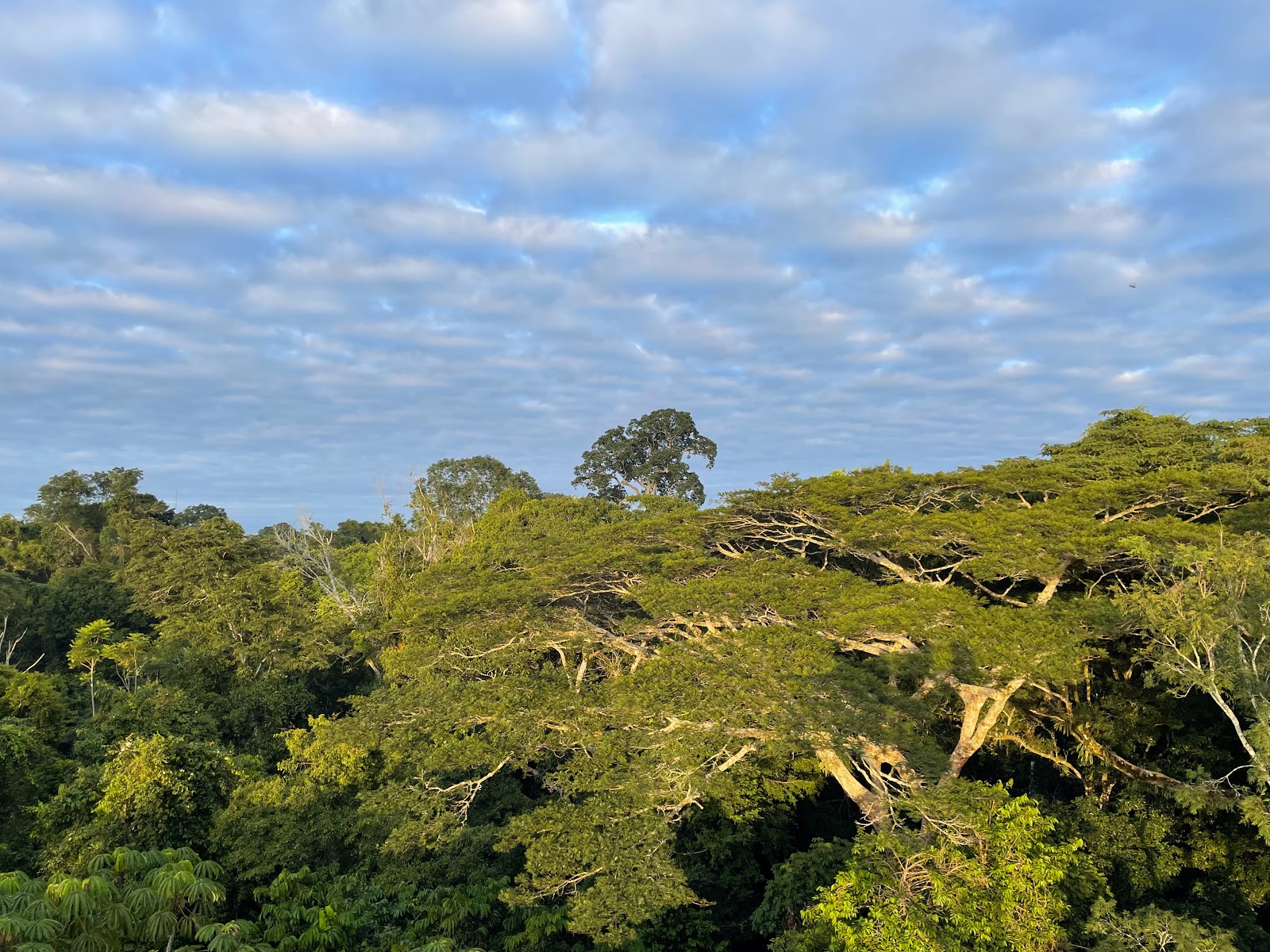
On our first morning at Refugio, we woke up before dawn - our goal was to watch the sunrise from the 30-meter observation tower that would bring us up above the canopy of trees. 

From the tower we could see the top of the canopy, and the
emergent layer (the tops of the tallest trees)

From the top platform, we had a stunning view of the endless sea of pristine forest, stretching for miles in every direction. Because we were above the overstory, it was much easier to spot the many species of birds that flock in the treetops.

Clockwise, from top left: White-fronted nunbird, blue dacnis,
yellow-backed tanager, mealy parrot
Just look at the gorgeous colors on these green and purple honeycreepers!

WHEW, it's hot up there!

Once the sun rose, it quickly got very, very hot so we made our way back down to the shade of the forest floor. One of the most sought-after sightings in the area is the Harpy eagle, one of the world's largest raptors - which can grow to be over three feet tall. 

Searching for that Harpy
A harpy eagle nest was located a few miles from the lodge, high up in an ironwood tree, so we went in search of this elusive bird. 

Jillian, waiting patiently in the blind


We spent about an hour at the blind and even went back in the afternoon, but the eagle didn't show itself. We did catch sight of the nest, though - so cool knowing that when the eagles finished it, it would be the size of a small room!!

The nest

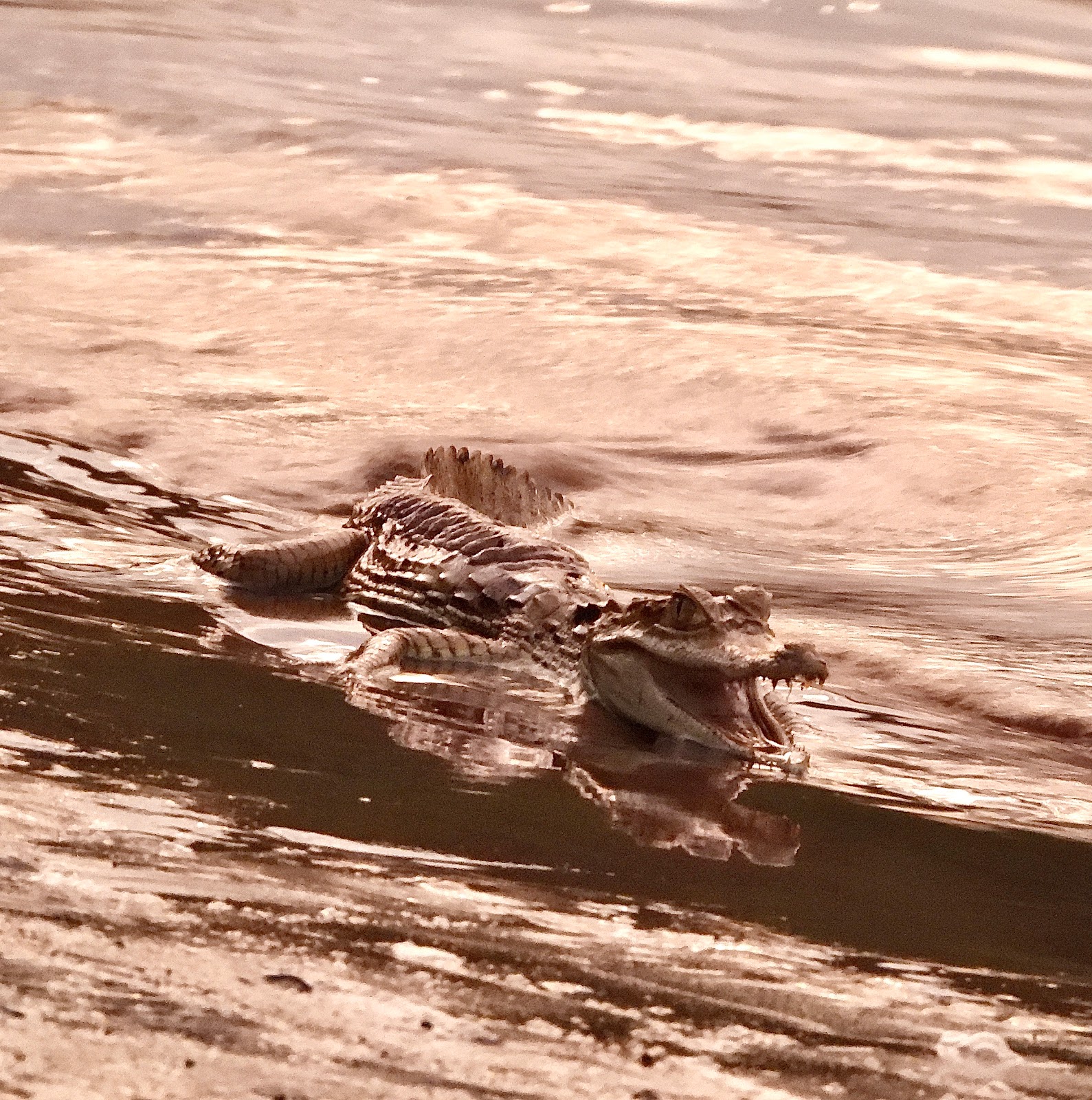
On another trip down to the river, we spotted this white (spectacled) caiman. The name 'spectacled' comes from the bony ridge between their eyes, that look like a pair of glasses. Caimans have more pointy snouts and longer, sharper teeth than their alligator cousins. 

Here's hoping for a snack!


Four different types of cacao!


We crossed over to the other side of the river to visit a local farmer, who allowed us to try the various fruits that were planted on his property. The most interesting to me was the multiple varieties of cacao - the flesh is sweet and delicious, and I would never suspect that their seeds to be the hidden source for cocoa!


One morning, we took a trip to Lago Condenado, an oxbow lake (formed by the shifting waters of the river). Along the banks, we saw a small flock of hoatzin, with their distinctive blue faces and red eyes.

It was hot on the lake, under the blazing
sun! Good thing we all had our 'hats'...


Click to enlarge photo. See anything??

In one of our more intriguing sightings, Paul pointed to a dead log up ahead and told us all, "I see at least five mammals there!" We didn't see anything, then he upped his number. "Six. No, seven. At least ten." After our hint that this animal could fly, we figured out that they were bats - but we still couldn't find them. 


It wasn't until we were parallel and could see their silhouettes that we finally discerned the upturned noses of these extremely camouflaged Long-nosed Proboscis bats.

Such great camouflage!


After paddling across the lake, we took a short hike to see the 'biggest tree in the forest' - a strangler fig that had completely encompassed a large tree. It was so big that it no longer needed the support of the host tree, and had outcompeted it (possibly by stealing all of its sunshine and sapping it of nutrients).
At the buttresses of the kapok
The inner tree had since decayed, leaving the strangler fig in a form that's known as a columnar tree, with a hollow core. It was so big we could all fit inside!
Inside the columnar tree - bigger than
most NYC studio apartments!


Near the strangler fig was a huge kapok tree, with lovely flying buttress roots. Kapoks are one of the tallest trees in the forest, which means they are vulnerable to gusts of wind up above the forest canopy. Because it has a shallow root system (which is common for rainforest trees because the fertile soil is at the surface), it forms the buttresses to help keep it from toppling over.

Vegetarian piranhas!
(but clearly not gluten-free)


On our way back across the lake, we stopped briefly to feed the piranhas. Did you know - piranhas eat bread?! 

Lago Condenado


We slowly hiked back to the lodge, enjoying the sights and sounds of the rainforest.

The indigenous people call this the penis plant...


We saw dozens of these walking palms - an interesting plant because of its strange, spiky root system. In a wild fit of fantasy, (and particularly in the inky blackness of night), one can only imagine a sinister horde of these, skulking their way towards our poor innocent explorers...


So many interesting trees and vines! 

1. The naked tree sheds its bark every season in order to rid itself of any parasites.
2. Vines are fascinating! Some start from above and grow down, other start from the ground and grow up.
All are looking for support in their quest for sunshine... but might kill their host tree in the process.
3. I was particularly intrigued by the leaves of this creeping vine that had plastered itself flat onto the trunk of the tree. 


Did you know? An epiphyte is a plant that grows on another plant, with no roots reaching the ground. They are divided into two categories - hemi-epiphytes and holo-epiphytes.  Plants that only live part of their lives as epiphytes are hemi-epiphytes - when their lianas reach the ground and they root (for example, a strangler fig), they are no longer epiphytes. Those that live their entire lives in the air are holo-epiphytes - like some bromeliads and orchids.


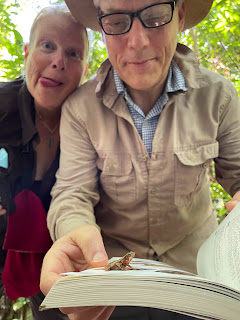
and this little frog who wanted to read about himself!
And of course, we had lots of fun animal sightings...  

Like this curious saddleback tamarin...
This agouti visited the lodge 
He's hard to spot, but there's a red brocket deer eluding the paparazzi 


Our guides are adept at using all their senses to stay alert and observant. They have so much knowledge - not just in recognizing the plants, but in listening to sounds and identifying smells. As we walked back to the lodge from the oxbow lake, Paul suddenly stopped our group - he had smelled some fresh sloth pee! (now that's an impressive nose...)
Sloths spend all their time up in the treetops, but about once a week they will climb down to pee and poop, then climb back up a different (but nearby) tree. So we all craned our necks looking for the sloth. And finally, the other guide Angel spotted it! It was a two-toed sloth, sleeping in a palm tree. Just his back was visible, but he did stretch up his back leg to show off his sharp claws!

Staying at Refugio was a wonderful introduction to the rainforest - and we couldn't wait to move even deeper into its heart - to the only lodge inside the National Reserve, the Tambopata Research Center... 

Tuesday, April 5, 2022

Amazonia, part 2: In the Heat of the Night

Our awesome guide, Paul
One of the nice things about our stay in Tambopata was having a local guide who stayed with us from airport pickup to dropoff. Paul was from the local indigenous Yine community, and his grandfather (who raised him) is the tribe's healer. He grew up in the jungle, and had so much knowledge of the rainforest and everything that lives here. 

Jungle fashionista
We were eager to get down and dirty into nature, so Paul said he'd take us out straight away. After settling into our rooms and enjoying a hearty and delicious dinner, we geared up for our first night walk into the forest. Despite the steamy weather (often 90°+ temps and 90%+ humidity), we tried to cover as much exposed skin as possible, with long-sleeved shirts and - as we learned - pants tucked into our socks. It was so hot and sweaty that I didn't bother to change out of my airplane shirt - who cares about matching in the jungle? 

Flashlights were an absolute necessity - but as I quickly discovered, headlamps are AWFUL - they attract so many bugs to your head that, unless you're wearing a mosquito head net, it's impossible to breathe without inhaling a new friend or two. And yes, I did have a head net that I pulled out on occasion, but it was usually too sweaty to keep it on. Oh, such problems! 

Nighttime brings out a whole different world in the rainforest. Not only are there a slew of nocturnal species that suddenly and mysteriously appear from nowhere, but there is something otherworldly about hiking through a dark and eerie forest that you know is teeming with unseen creatures (half of whom are probably stalking you 👀). 

There is a constant, intense symphony of noises - clicks and buzzes and growls and cracks. It's not just the thrum of thousands of insects, but the chirping of frogs and the rustle of... snakes? lizards?? rats??? 

Larger creatures snap twigs, night monkeys break branches overhead, and that flap and swoosh in the air could be from a bat, a bird, or a very very very large moth. And the most unsettling thing is... you can barely see any of them.

Fairly early into our walk, a yelp (ok, maybe a scream or two) came from the front of our little expedition. Our party had wandered over a swarm of army ants, who proceeded to crawl up onto the legs of those unfortunate ones up front. I was near the back of the party, and ran like Usain Bolt across the ant field, avoiding getting bitten. Lucky me! I knew being a slow and lazy straggler had its benefits! From this experience, we learned 1) tuck in your pants into your socks, to avoid things crawling up your leg!! 2) be hyper-vigilant where you're standing, or you're sure to pick up a hitchhiker, and 3) it helps to jiggle or hop around when you stop, like a bunch of toddlers desperate for the bathroom.

Up high? Down low? GAAAH! So much to see!
Sometimes it was hard to know where to shine our flashlights. In the trees overhead we were looking for sloths, porcupine, kinkajou, monkeys, and snakes; down below we tried to spot big cats (ocelot, puma, jaguar, margay, jaguarundi), peccaries, tapir, armadillos, and anteaters. 

We were looking for the flash of light reflecting in eyeballs - and it was fascinating (horrifying??) how many spiders (and cockroaches!) are around (did you know spider eyes shine in the light? Go out in your backyard at night - you'll see!). It was a lot. Like, a LOT a lot. And we're talking H-U-G-E ones, the size of my open hand... (more on spiders and insects in a separate post!) 

Just look at the size of those eyeballs!
Perhaps one of the more exciting sightings of the night was this family of night monkeys, the only nocturnal monkey and one of seven monkey species found in the area (the others being the spider monkey, squirrel monkey, dusky titi monkey, red howler monkey, capuchin, and saddleback tamarin - and during the course of our stay, we saw them all!).  Did you know? Night monkeys pair bond, and the father is the primary caregiver of the single baby that's born each year!


As the science nerds that we are, Jillian and I also brought along blacklights so that we could check for glow-in-the-dark treasures. (Did you know? Some organisms fluoresce, which means they absorb light from one wavelength and emit it at another. It is unclear why they do it - maybe to attract mates or prey, or to warn away predators.) 

Cool eggs! What will they hatch into???
On several occasions, we turned off our flashlights and only used the blacklight to see what we could discover. Occasional flashes turned up some really interesting finds, most of which were fungi and molds that fluoresced yellow and green. 

But we also found some glorious spiders and scorpions!  It was fun turning on and off the flashlights vs the blacklight, especially since some creatures only had patches of fluorescent areas - like this crazy spider: 


Also, did you know that almost all scorpions glow in the dark? As if they weren't oogie enough!
We really wanted to see one, and it is amazing how much easier they'd be to spot if you had UV vision... dang my limited eyesight!


((On a side note, I now realize my night-vision totally sucks, and my day-vision isn't so hot either. But wearing glasses is horrid in the steamy jungle - they kept getting fogged up and sweaty so I stopped wearing them. Amazingly, as the week progressed, my vision grew accustomed to hunting through the trees, and I found I could see much better. I also noticed that almost no local wore glasses - I asked Paul and he confirmed it. I tell ya - looking at trees is way better for your eyesight than staring at a screen! See? I'm testing your eyesight right now...))


That's a porcupine behind those twigs!
One of my favorite experiences of the trip was the night walk that I did with just myself and Paul. It was later in the week, and after so many hot and exhausting days, everyone else opted out. But it meant for a much quieter hike than with our usual chatterbox group, and we ended up encountering so many elusive species! I didn't get photos of the olingo (a small monkey/cat type mammal that resembles the kinkajou) since we only could catch glimpses as it foraged in thick branches, but we did spot a porcupine high in the trees (Paul found it because he could smell porcupine pee and knew when to start looking!!!) 

I was also quite proud of myself when I spotted this barred forest falcon: 

Little tinamou sittin' in a tree,
s-n-o-r-i-n-g ðŸŽ
We also saw a tinamou (who is usually shy, secretive, and ground dwelling), and tons of spiders, beetles, and animal tracks. 

More interesting was when we heard the raspy, guttural growl of an ocelot, very close to us and moving through the brush. We turned off all our lights and waited in total darkness for about 30 seconds (which, lemme tell you, is a LONG time in pitch blackness!!) in the hopes that it would come closer (longest 30 seconds of my life!!!), but sadly it didn't show itself. 

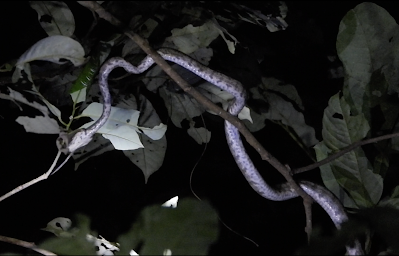
It was obviously much harder to get photos of everything we saw in the darkness, but during our week of night hikes, we were lucky enough to catch glimpses of a caiman and a bamboo rat. And on another evening walk, Anil spotted this beauty - an Amazon tree boa. Glad it didn't drop down onto our heads!!


Nighttime is also when so many more frogs appear - we can constantly hear them all day, but a lot more can be found at night - perhaps because their big eyes easily reflect our lights. 

Rough-skinned Green Treefrog says hello! 
This bad boy is called a Gladiator Treefrog because he'll
fight any other frog who dares hop on his tree...
Go on! I dare ya!


The rainforest really is an extraordinary place to explore at night. Forget New York City... for somewhere that truly never sleeps (and has a LOT more cockroaches), you can't beat Amazonia!! 

Saturday, April 2, 2022

Adventures in Amazonia: Arrival in the Rainforest


When I think of the Amazon, I think of a vast green swath of impenetrable forest filled with colorful birds and howling monkeys, stinging insects and prowling jungle cats. There are snakes that can kill you with venom or a squeeze, ants whose bite feel like cigarette burns or gun shots, and plants that can, depending on the dose, cure you of almost any ailment... or render you blind or possibly kill you. It is by far the most diverse and fascinating biological hotspots on the planet, so of course I jumped at the chance to go. 

The original trip was scheduled for April of 2020, and Anil and I were supposed to go with my Nat Geo entomologist friend Aaron, who had done his field work at the Tambopata Research Center. With the delay, Aaron was no longer available, but instead we brought along David, a Professor of Forest Ecology at Cambridge who did his field work in the rainforest of Venezuela. I also invited Jillian, a science teacher friend who studied forestry and who would help with curriculum development. And David's son Samuel came along as our student consultant! 

We planned to visit two ecolodges in Madre de Dios, Peru - both along the Tambopata River. We'd stay at the Tambopata Research Center within the Tambopata National Reserve, and just one day before our arrival, Refugio Amazonas reopened after the COVID closure, so we would be some of the very first people there in two years. 

Our flight took us first to Lima then to Puerto Maldonado (Jillian and I were delayed about 4 hours so we missed our connecting flight and had to meet the boys at the lodge) where we were picked up at the airport and taken to the headquarters of Rainforest Expeditions (who ran the lodges). We then had a 1.5 hour bus ride to the river, during which we could see how the forest had been clear-cut, for farming - lots of papaya grown here! After a bumpy ride down a dirt road, we were dropped off at the loading area. 


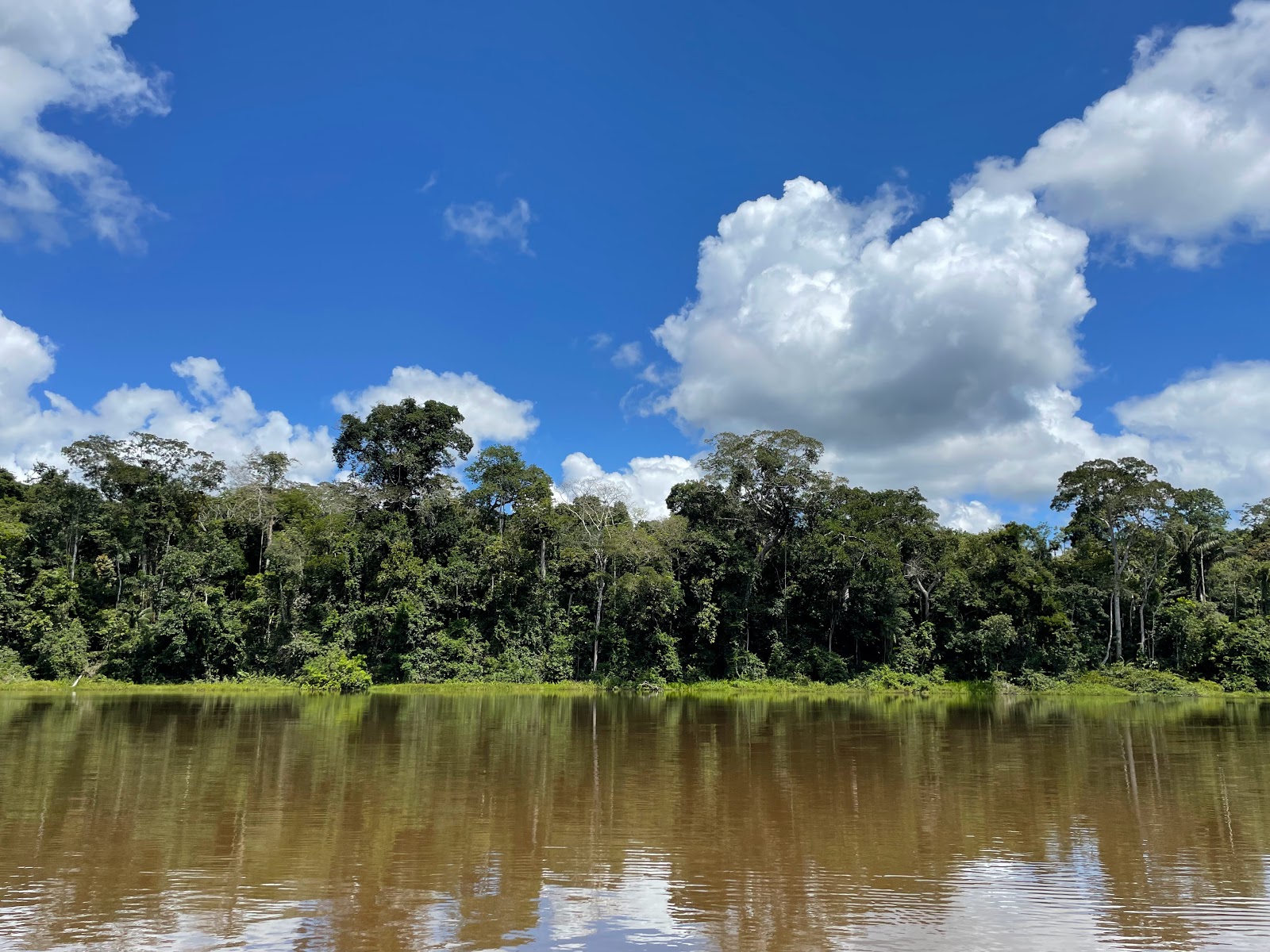
The first glimpse of the Tambopata was of a muddy brown river, with banks covered in thick vegetation that led straight down to the water. There are so many kinds of plants here - from palms, grasses, and canes to towering kapok and ironwoods dripping with lianas and epiphytes. Already the air was heavy with heat and humidity, and we all welcomed the breeze from the moving boat.
 
The Tambopata River

Lunch was served along the way, which was a delicious leaf-wrapped fried rice, banana, plantain chips, and brazil nuts. 

About halfway into our trip, the boat driver suddenly cut the engine and one of the guides pointed at the bank: "Capybara!" he whisper-shouted, "in the grass!" We all strained to look, but we couldn't see anything. The boat backed up until we were parallel to the area where the guide was pointing, and finally some movement caught my eye - our first large animal sighting! Capybara are huge, lumbering rodents that look slightly like a guinea pig on steroids. While they are semi-aquatic, these two were hiding in tall grass, then moved up the hill and into the bushes.
The "boat dock"

After an hour and a half of motoring downriver, we pulled up to the boat dock (which was really just a mud bank) and took a short hike through the rainforest. 


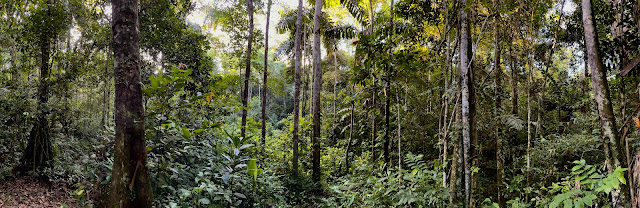
While the trees tower over us leaving the understory in complete shade, the ground was still completely covered in younger trees, bushes, and vines. The walkway we went on was really wide and well maintained, but you still couldn't see very far through the twisting path.

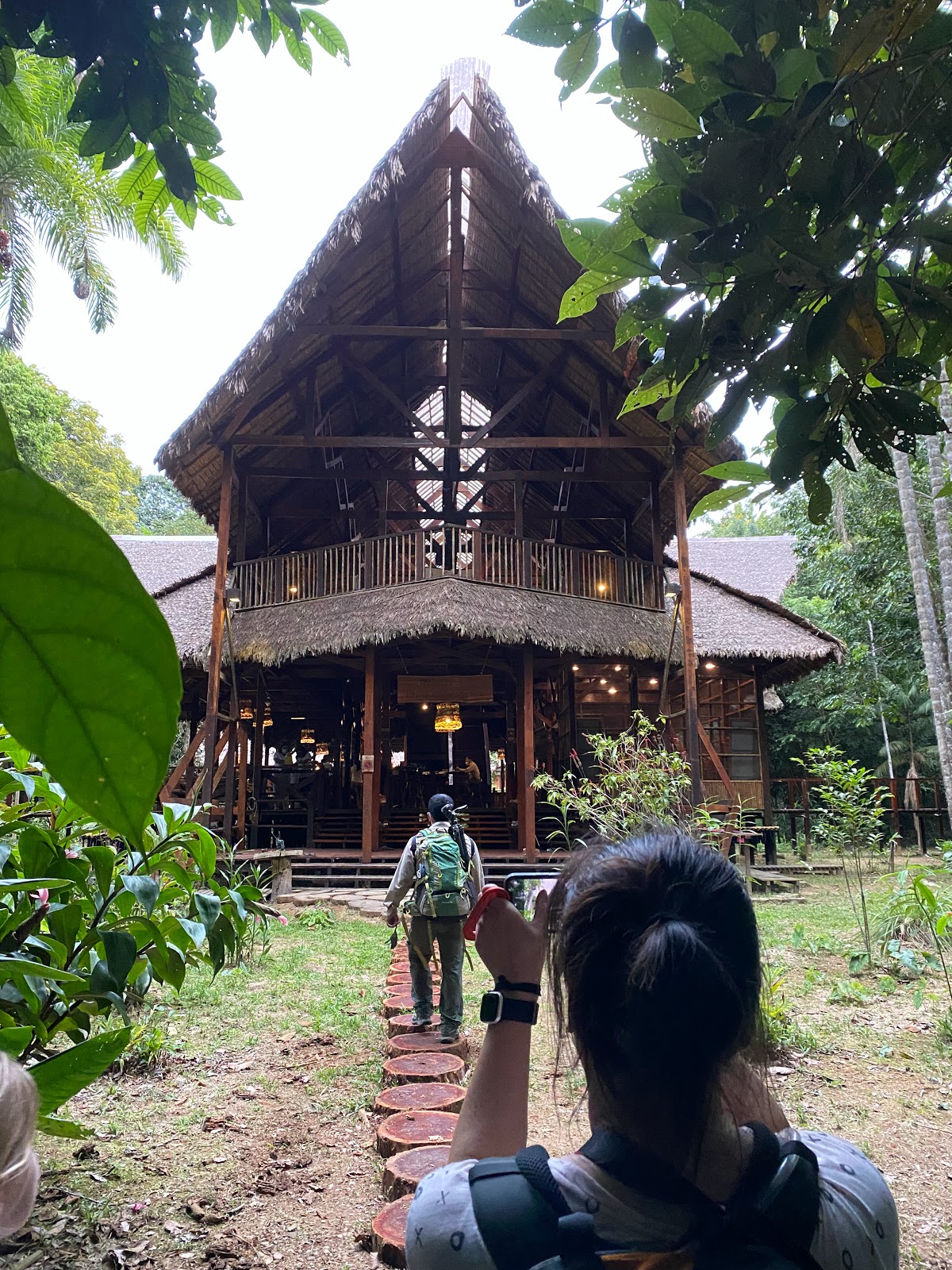
So it felt a bit surreal when the vegetation suddenly broke away and before us was Refugio Amazonas, the ecolodge where we would spend the next four days. 

Where were we, Fantasy Island??


No joke, this is a five-star resort plunked down in the middle of the jungle! 

...well, a five-star resort whose rooms only have three walls... the fourth is completely open to the rainforest! 


Thank goodness for
mosquito nets!
But it brings nature much closer to the guests, and even though we had plenty of visitors, there was never much** of a problem in the room since we slept under a mosquito net and had a safe where we kept any snacks.


**particularly since the opposum that visited in the night just wandered around without disturbing my things, and I made David catch the palm-sized cockroach that was flying around my nightstand...


The next week is sure to be AWESOME!!!!!

Friday, December 31, 2021

Finland part 2 - Lapland

Kakslauttanen is definitely a resort that was built and designed for max tourism. Yet even so, I loved every moment of it. 

The cabin we stayed it was called a Kelo glass igloo - a cozy log cabin with a small kitchenette, bathroom with attached sauna (which we used almost every day!!), wood fireplace, and attached half igloo. Along with the main bed in the middle of the cabin, there was a bunk bed and two twins in the igloo. 
Our home for the week!

Not a bad place to hole up for a week, but outside there were plenty of things to do. Breakfast and dinner were included and served at the main reception area, across a small river about a 10 minute walk away. Every time we ventured out of the cabin was an ordeal - we had to get fully bundled up, and remember to bring our masks and mittens and hats.

On Christmas eve, we went dogsledding, which was perhaps the most fun thing we did the entire trip. I started off as the passenger, riding in a caravan of about 15 other sleds. Each was pulled by 6 dogs - the front two were leading and guiding the sled, the middle two were 'in training',and the two closest to the sled were the strongest pullers. For the most part, the dogs at Kakslauttanen were Siberian Huskies - bred to withstand the cold and known for their strength and stamina. And it was pretty clear that the dogs wanted to run - even walking up to the sleds, they were super excited and pulling and jumping, ready to go. It was an infectious energy! 

At the beginning, the guides moved Anil and I to a team of feisty dogs since the older couple who they had originally been assigned to wouldn't have been able to handle them. We followed a trail through the woods, which was easy since the dogs just followed the team before it. At around the halfway point, we switched and I got to be the driver. The harder part was slowing and stopping the sledge. On the downhill, we had to slow down so the sledge so the dogs wouldn't get run over, and on the uphills we had to either help push with one leg, or jump off and help push and then jump back onto the small runners on the sides. We were supposed to keep around 5 meters between each sled. When we were stopped, I had to stand on the break and lean my entire weight backwards, since our team was so eager to keep going. They definitely seemed happy to run. 
Afterwards we stopped for a salmon soup lunch in a teepee in the woods, then went around to see the kennels and the puppies that they were training to be on future husky teams. They let us into the pen with the 3 month olds, and it was so fun having them crawl all over us! There were 150 dogs at the kennel, and the guide knew all their names; each had their own little house, but a lot of them were outside sleeping in the snow. 


The next morning was Christmas Day - we stayed in and had a lazy start, and made rice porridge for breakfast. Since we had the entire day free, we had a fun snow day - sledding and making snow angels.
It's so cold in Lapland that the snow is really fluffy and dry and fun to play in. Someone had left a sled at our cabin, so Ev and I made our own track on the hill down to the river - it took a few mishaps, but we did it! 

Reindeer shoulder, roasting on an open fire
Since we had an evening excursion, we made early dinner reservations at the local restaurant that we'd heard was good - Laanilan Kievari. Since it was 4:30, nobody else was in the restaurant, so it made it a lot more comfortable for us. There was a cheery fire in the open fireplace, which ended up being where they cooked the reindeer shoulder that we had for dinner. The best part was dessert - the 'snowball' - yum! 

That night we had an aurora hunt on a reindeer sleigh. The ride was freezing cold, even though we all had foot warmers in our boots and multiple blankets covering us. Each sleigh was tied together, forming a chain that was led by a Sami guide who was walking through the dark forest. Sometimes, the reindeer behind would go a little faster and catch up to the sleigh ahead of it, which means it would be right next to the rider. Our reindeer, who was right behind Mark and Ev, would constantly poke Mark with his antler. Even though the sky was clear and stars were shining that night, we didn't see the aurora even after stopping at a clearing in the forest. Instead, we talked to the guide and had a hot juice in the teepee. All in all, an amazing Christmas! 
Reindeer sleigh ride on Christmas? Why yes, please!

The next day we had no activities planned, so Ev, Mark, and I decided to go cross country skiing. It was a nice day, so we drove over to the Kakslauttanen East Village, about 2 miles down the road. It is a much smaller and quieter resort, near a large open cross-country ski and snowmobiling area. We headed off without really knowing where we were going, but the tracks are so well maintained that it was easy to follow. It was nice being out and getting some exercise, since it was so easy to just stay cozy and lazy inside! 
Hot cider and snacks in the middle of the forest!
Another fun activity was horseback riding, which was the next day's activity. You didn't need to have any riding experience to enjoy this ride, which was good since Anil had never been on a horse before! They suited us up in jumpsuits and we set off - this time not only through the forest but by a river where they mine for gold in the summer. We rode Finnhorses - fuzzy, stocky horses that are slightly bigger than Icelandic ponies, with a shaggy coat that keeps them warm in the snow. Along the way we saw a herd of reindeer running through the forest - always a thrilling sight!  

On our last full day in Lapland, Anil and I did an all-day trip to go snowmobiling, ice fishing, and visit the Sami museum. We rode about 2 hours north, past Ivalo (where the airport is) to Inari - on the banks of Lake Inari and the capital of Sami culture. After first getting geared up (with a jumpsuit and helmet), we set off across the frozen Lake Inari on snowmobiles. We started with Anil driving, and sitting in the back was cold! 🥶 

We made it to our fishing spot and watched as our guide showed us how to set up. He drilled a hole using a hand drill, then - as he was demonstrating how to set the hook in the right spot, caught a small lake perch! I didn't have as much luck - and we weren't outside for too long before it started getting too cold (and it was time for lunch). We went into a small cabin for more salmon soup (that seems to be the standard lunch fare, but honestly, it was deeeelicious. And warm and hearty - perfect for when you've been out freezing!) 

Before heading back, we stopped at a small Sami church, which had originally been built in 1624 (!). It was damaged in WWII when the Nazis occupied Lapland (they burned everything as they retreated), but was rebuilt. It has no heating and no roads to get there, so most people get there by snowmobile. I drove the snowmobile on the return trip - it was a lot harder to handle than I thought it would be, as I had to fight the steering just to keep it going straight. It was exhausting, but at least it kept me warm as we crossed Lake Inari! 

We then went to Siida, the Sami museum. The main portion of the museum is the open-air architecture exhibit, where we could visit several traditional Sami buildings, including farmhouses, a courthouse, storage huts, and (my favorite) - an animal trap. The Sami are actually the only indigenous group in Europe, and they currently live across Lapland - in northern Norway, Sweden, Finland, and Russia. The site of the Siida museum is a protected archaeological site dating back to the stone age, over 10,000 years ago. 

The trip to Lake Inari was a great way to end an amazing time in Lapland! Overall, I loved Lapland - the activities and the scenery and the culture. Looking forward to returning, and encourage everyone to visit!