Saturday, February 6, 2016

Excavation of #IS013 - an unhatched leatherback nest

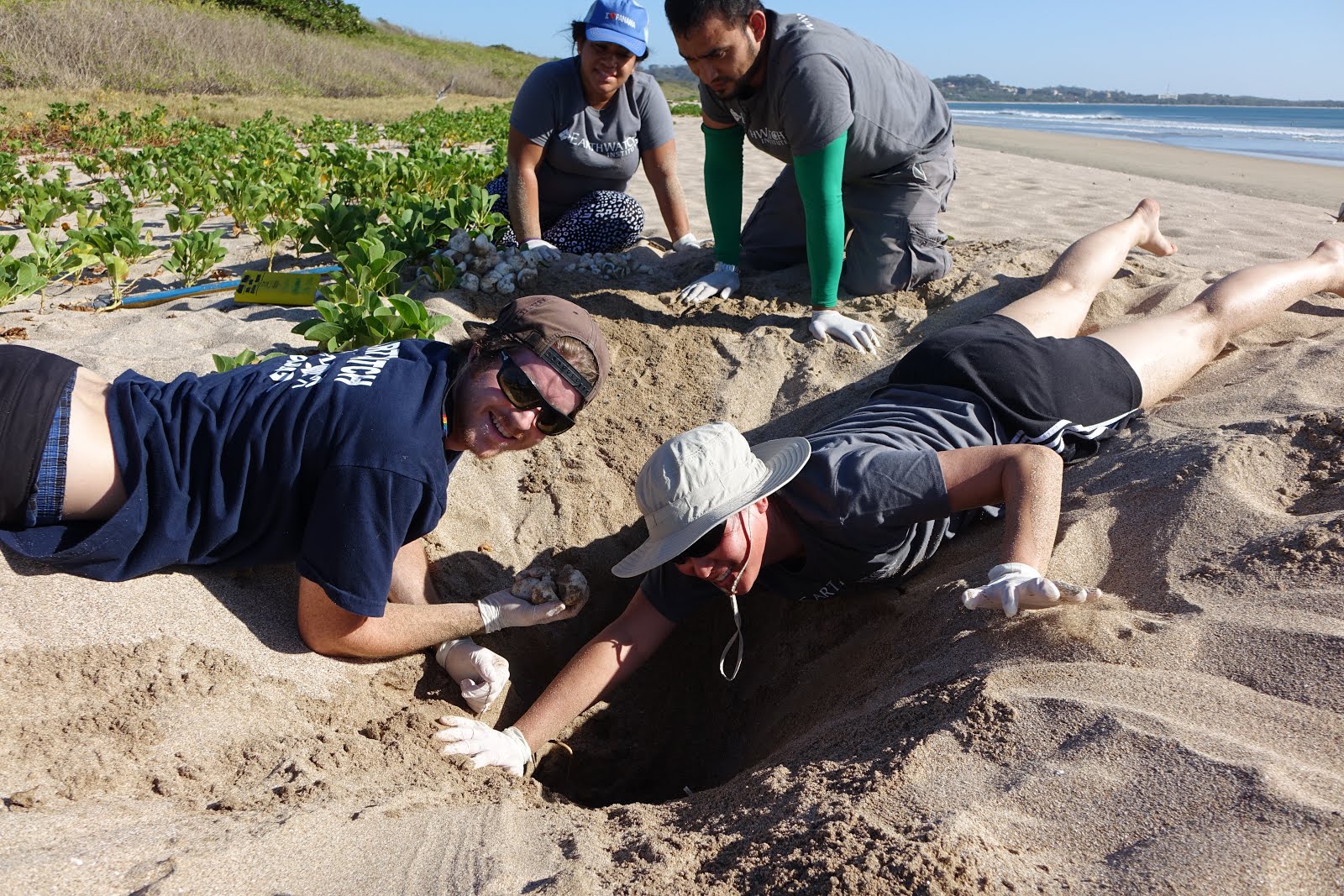
Yesterday afternoon we went to the beach to excavate a 70-day old leatherback nest. Normally, turtles incubate for about 60 days before they hatch. The nests will then be dug up to gather data, and any remaining turtles who haven't reached the surface will be released. In the case of this nest, there was no sign of hatchlings on the due date so after waiting 10 days, the biologists decided to excavate.


Biologist Brett walked us down to marker 10 and easily found the nest, marked by a small pile of upright sticks. The first step was to clear off the dry sand to prevent a collapse after we started working down in the egg chamber.
Measuring the depth of the topmost eggs: 61 cm


We then started digging, looking for the first sign of eggs. When the first egg is spotted, we stop digging to measure the depth. 


Then it was time to collect. Brett and I removed the eggs, putting them up onto the sand. It wasn’t as easy as it sounds – leatherbacks are huge animals, and the nest was close to 3 feet deep. Brett had longer arms (and more experience!) than I, so I had to fight to not fall into the nest and crush all the now-rotten eggs. When we got everything out, we re-measured the depth to find out the depth of the original egg chamber (76 cm - about 2.5 feet down).
I almost fell in!!


     Thank goodness for Justine!!


After measuring the final depth of the chamber, the eggs were sorted by Milixza and Alan, who pulled out all the SAGs. SAGs are shelled albumen globes, unviable eggs that are filled with egg whites but have no embryo. A few are the size of the regular eggs, but most are much smaller - some as small as grapes. We threw those back into the egg chamber and counted the remaining eggs. Of those, one had actually hatched, and we needed to stage the remaining eggs.
Brett sifting through the rotten egg, looking for an embryo

One egg had pipped, meaning the hatchling was fully developed and had started breaking out of its shell but didn't make it. For the rest, we opened the egg by pinching the shell between our fingernails and tearing it open much like you’d open a potato chip bag. One by one, Brett, Mili, Alan and I opened the eggs to find out what stage development the embryo had reached while Justine recorded all the data in the logbook. The first few eggs I opened were completely mushy inside (one was even crawling with maggots), and Brett had to carefully sift through the rotting goo in an attempt to find an embryo. If we couldn’t tell what it was, it was considered “unknown”.

Getting our chance to stage eggs
A Stage 3
The majority (66) of the eggs were fairly far along in their development, meaning they had reached stage 3.  Some had been liquified by some sort of bacteria or other factor and we could only tell by the splotches of black in the goo that there had been anything,  but more often it was just a formed embryonic hatchling. When we were done, the nest - with all the SAGs and opened shells - was covered back up.
The logbook of data. "IS" nests are "in situ," meaning they are in their original positions on the beach. "H" nests were relocated into the hatchery. Note the success rate of the IS nests... not so great...
Because so many of the eggs had gotten fairly far in their development, Brett speculates that one possible reason for their demise was the temperature was too high – this area of Costa Rica is suffering from a major drought, exacerbated by the El NiƱo. This season, the leatherback nests on the beach have not been doing well - in general around 50% of leatherback nests are successful, but this year the number is way lower - around 15-20%. 

Anyone who doesn't think climate change is a thing, come down and visit the sea turtles...

Friday, February 5, 2016

Beach Patrol

The Goldring-Gund Biological Station here at the Parque Nacional Marino Las Baulas is charged with protecting the sea turtles who lay their eggs here. To do so, we patrol the beaches at night, when the turtles are most likely to nest. The patrol times are set by the high tide - we begin 3 hours before the high tide and end 3 hours after. The beach is marked by posts every 100 meters and is divided into three sections: South (marker 36 to marker 21), North (21 to 6), and Ventana (6 to 0, and continuing up Ventana 0 to 11).
The panorama of the beach from just outside the hatchery - South at the far left, North to the left, and Ventana to the right
I patrolled North last night, going from marker 21 to marker 6. Each marker denotes 100 meters, so each “sweep” is approximately 1.5 kilometers (about a mile). We walk down for 20 minutes, rest 20 minutes, then walk back for another 20 minutes… back and forth for the night. If there are no turtle sightings, we’d walk approximately 6 miles… in sand. And since we’re required to wear closed-toed shoes, the sand that gets stuck in our socks makes for some really lovely blisters…

For the North patrol, we drive with the South team to an entrance near marker 29. Our first sweep took us a bit longer to get to marker 6, where the station is and where the hatchery is located. North is nice because you take your breaks with other groups - to the north we stay at the hatchery and can go back to the station for the restroom or more water; to the south we meet up with the South patrol (Nathan, Dean, and Adrian) up on the berm. 

Our group consisted of biologist Lauren, Suzanne (a retired professor from Minnesota), and I. We started our patrol around 8PM, and for four and a half hours, all was quiet. Every so often we'd run into a buscador - one of the guides who look for turtles for paying tourists. Many are former poachers, but now help finding turtles and with conservation (more turtles = more tourists = more $!).

South and Ventana also didn't see anything, which was upsetting for us since the night before, two groups had olive ridleys. We had all just about resigned ourselves to a quiet night when suddenly, on our final lap up, a red light flashed from up the beach. It was past midnight, so it was either the park police (MINAE) telling us they were leaving, or it was a turtle. 

And 5 minutes later, we spotted the distinctive large black tracks coming from the water up onto the sand. A small group of buscadors and tourists were standing over a leatherback, who was in the process of digging her egg chamber. She was huge - about six feet long and three feet wide. Having dug her self into a body pit, she was scooping out the sand alternating between her two back flippers. When she couldn't reach down any further, she was ready to lay her eggs.

Our job was to take measurements of the turtle and count her eggs. Suzanne, who was doing the counting, crawled on her belly behind her (as not to collapse the egg chamber) and looked down into the pit. With one hand, she moved the turtle's flipper aside to get a good view of the eggs. The eggs are the size of billiard balls, and she lays 1 to 4 at a time. Every so often she would also lay a SAG, a smaller infertile egg, which we do not count.

In the meantime, Lauren and I took data. While sea turtles are in the act of laying, they go into somewhat of a trance - which means we could get right up close and even touch her. Lauren scanned the turtle's left and right shoulder to get the tag numbers, then we measured the width and length of her carapace (shell). All the information was recorded, then we just waited for her to finish her job.


While we were collecting our data, both the Ventana and South teams came to watch. Nathan showed us different parts of her anatomy, and we were all allowed to touch her flipper (it felt like old lady skin - soft but wrinkly). When the turtle was finished laying and had covered her eggs, she camouflaged the area. Moving slowly around, she used her enormous front flippers to throw sand behind her. Then she'd use her back flipper like windshield wipers to smooth it out.

When she was finally finished, she slowly made her way back to the water. The city of Tamarindo is on the south end of the beach, and it is clear how much the lights affect the turtles. Every so often, she'd get confused and turn the wrong way, towards the lights. Eventually, she figured it out and finally disappeared into the water. The entire process took about 2 hours - it was 2:30AM when we finally got back to the station.


The next morning, the Morning Walk shift could see her convoluted tracks:


Best of luck to those 68 eggs!!

Thursday, February 4, 2016

Excavator Extraordinaire


So this happened...


The olive ridley nest from yesterday had pretty much finished hatching, so it was time to dig it up and gather data on the eggs. We scooped up the sand from the pit, dumping it into a sifter and pulling out the shell fragments, unhatched eggs, and any remaining turtles.


Olive ridley eggs are about the size of golf balls (leatherback eggs are billiard-ball-sized) and are not hard like chicken eggs - instead, they are slightly squishy. After rescuing all the stragglers, we sorted the shells, counting anything larger than half a shell and discarding the smaller bits. The whole eggs we set aside in a separate pile.


Then it was time to stage the eggs: figuring out what stage development the unhatched eggs had reached. To do so, we put on gloves and tore open the eggs. If we found nothing, the egg was considered stage zero. Several of the eggs that we opened were just like a raw egg (clear liquid with a yellow yolk), or was a soupy mush, or had a reddish tinge indicating bacteria growth. Some were pretty rotten and smellllllly!! Others had actually started developing...
Stage 2
Pipped

An embryo with no eye development but with blood vessels is stage 1, an embryo with a developed eye but no pigment is stage 2, and an embryonic turtle with pigment is a stage 3. Any turtle who broke open his shell but didn't get out is considered "pipped."


Here's biologist Nathan opening an unhatched egg and finding a Stage 3:

It was kind of sad seeing so many unhatched babies, but then we played with the bucket o' hatchlings and I felt better...


Wednesday, February 3, 2016

The First Day

OK, now that I've had a good night's sleep and a nice* shower, I can actually remember everything that happened yesterday...

*and by nice, I mean a trickling cold shower because of the water regulations in effect here. They are in the third year of a horrible drought, and there are usage restrictions... sound familiar??

I actually left California on Monday evening, on a red-eye flight to Miami. After a long layover, I flew directly to Liberia, the main airport in the Guanacaste province. If you look on a map, Costa Rica is almost directly south of Florida, so it was actually a fairly short flight. We flew over Cuba, the Cayman Islands, and Nicaragua.
Looking out the airplane window over Nicaragua, I spotted this smoking volcano:


UPDATE: just got back from breakfast and saw a report about this volcano on the Costa Rican news! But it was all in Spanish so I can't tell you anything about it...


Jack and Amy, trying to figure out how to get into the Station Fortress...


I met Amy (who works with Earthwatch) and Jack (a teacher from Manhattan) at the airport, and we took the hour-long shuttle to Playa Grande where the station is located.


The rest of the group was off doing an excavation, so we took a tour of the station from Nathan, one of the biologists. We played with the bucket o' hatchlings until the others returned, and Nathan gave us an overview of what we'd be doing.


The house is divided into two sides - one for the biologists (there are 7 or 8... we haven't met them all) and one for the 11 volunteers. My roommates are Justine (a teacher from Salinas) and Mili (a biology student from Panama).

There are many different jobs to do, and Nathan gives us a new assignment every day. All the information we need is posted on a whiteboard outside the biologist's side of the house.

On the upper left side of the board, 'Marea' tells us when the evening high tide will be: important because the leatherbacks don't like traveling on land very far, so they wait until high tide and crawl the shortest distance to dry land. If the eggs are laid too far from the water, the sand is too dry and their egg tunnels will collapse; if it is below the waterline, the eggs will drown. The start and end times tell us when we will be doing night patrols.

V, N, and S, are areas on the beach (MW is the Morning Walk, from 5:30-8AM to find any stragglers) - that's where the patrols will be. Each patrol walks out 20 minutes, rests 20 minutes, and walks back 20 minutes - this is because Leatherbacks take about an hour to nest, so we'll never miss one.

The hatchery is guarded 24-7; we monitor the nests every 30 minutes (because thats about how long it takes for a baby to dig itself out of the sand) and protect the hatchery from predators (raccoons, coati, porcupines, etc.) You'll see my initials for the 18-00 - that's the 6PM to midnight shift. LC, one of the biologists, actually did it from 6-7:30 while we were at dinner.

The last thing on the board is the tally for Baulas (leatherbacks), Loras (olive ridleys) and Negras (black- same species as green) turtles. The turtles are tagged with microchips in their shoulder (the exact same chip as cats and dogs have), so when a turtle nests, the biologists can tell if it has been here before. The 20 baulas mean 20 different individuals; turtles nest on average 7 times each season, so even though we may see a nesting leatherback, it likely will be a returner and the tally won't go up.

Mmmmm, dinner...
When I first found out I was coming on this trip, I was 94% excited and 6% scared. It was scary because I had no idea what I was getting myself into, and I only had 7 days to prepare. As luck would have it, I found out that Dean Lorenzo, a teacher from Saratoga was also coming. I met Dean last summer at the Monterey Bay Aquarium teacher seminar, so it was nice having someone to bombard with questions before we left!

We had dinner at Kike's, a local restaurant about 800 m from the station. We only eat two meals a day - breakfast at 11AM (late to
give the late-nite patrols some time to sleep) and dinner at 6. Every morning we get a menu and pre-order that night's meal.

After dinner we quickly got dressed (long pants to protect from sand fleas, official Earthwatch shirt to allow us on the beach after hours, sneakers for walking around in the dark) and headed off to our duties. We all have headlamps with red filters - turtles don't see in the red spectrum, and white light confuses and scares them. This also means no cameras after dark... so look at this and imagine it on a moonless, eerie night...


Each nest is covered (so the little turtles can't escape... this is basically Alcatraz for hatchlings) and a thermometer is attached so the biologists can monitor temperature (which tells them when the nest is due to hatch). We had a nice blanket and chairs to sit on, and every 30 minutes we needed to check the nests.

For four and a half hours, we chatted, stargazed, and -as Justine so eloquently described - guarded sand. But in the last 10 minutes of our shift, all the action happened. We babysat little turtles, scared off predators, discovered new hatchlings, and did the release.

By the time I got back to bed, it was 1:30 in the morning and I fell into an exhausted, much needed sleep!


The Hatchling Queen

A quick update since I haven't slept in 2 days, but...


What a welcome to Costa Rica!! First thing we saw upon arrival at the Goldring-Gund Marine Biology Station was this bucket of not-quite-day-old olive ridley hatchlings, who were kept in a shed for protection. All but one survived, and we released them just a few minutes ago!


Justine and I just got off our 7 to midnite shift guarding the Hatchery. (Yes, we did our job and fought off* a viciously attacking** raccoon/coati). And at the very last nest check, we found three new hatchlings fighting their way through the sand!

*by "fought off" I mean 'I stood up and it ran away.'
**by "viciously attacking" I mean 'curiously sniffing.'

Now exhausted - going to bed!


MORNING UPDATE: Alan, one of the other Earthwatch volunteers who is a guide from a park in southern Costa Rica, says what we saw was most likely a coati - because the tail was standing straight upright. COATI, I OWN YOU!

Monday, January 25, 2016

Earthwatch Teach Earth Fellowship, here I come!!

Good thing I'm used to going with the flow, because I'm thrilled to be scrambling around trying to get ready for my Teach Earth Fellowship with Earthwatch... traveling to Costa Rica to work with sea turtles! I just found out last Friday, got my paperwork this morning, and am leaving in ... exactly one week. WHAAAAAA?!

I'll be joining 3 other teachers as well as the regular Costa Rican Sea Turtles expedition participants on this trek. The primary goal of the expedition is to study the ecology of the endangered turtles that nest on the beaches of Parque Nacional Marino Las Baulas, on Costa Rica's Pacific coast. We'll be working with leatherback, olive ridley, and East Pacific green turtles. More importantly, I'll get to facetime in to my classroom so that my students can talk to the researchers, ask questions, and see actual science in action.

Haven't booked my flights, done any packing or shopping, or gotten all my paperwork in order yet... lots to do in the next few days!

Tuesday, June 16, 2015

Wildlife watching in Yellowstone

One of my favorite things about the United States is our National Park system. Seriously, our parks rule! And while I try my hardest to go as often as I can, it isn't always easy to truly appreciate everything that our parks have to offer. That's why I'm so grateful to the Yellowstone Association for their scholarship so that I could attend the Lamar Wildlife Getaway!

The iconic animal of Yellowstone is the bison, and they truly are majestic. Large herds graze in the Lamar Valley, where we spent quite a bit of time just watching them do their thing.


It's hard to tell in this picture, but this baby had just been born and we could actually see the afterbirth still attached to the mom. Sadly, our guide Carolyn said the birth was a bit late in the season and it would be hard for the calf to gain enough weight to survive the next winter...

The program took us on several hikes each day, and it was gorgeous. The group consisted of about 12 people, including three other teachers. We had two guides with us each day, who helped with spotting and with setting up our scopes. Carolyn and Carlin were absolutely amazing, seeing things that I ever would have found. Note to self: get a professional guide if you want to have a fuller, richer experience!!


Everyone is always excited to spot bears, and we were lucky enough to see several, including this mom black bear and her two cubs. We were hiking off-trail, and almost ran right into them. During the trip, we also saw several grizzlies, but mostly from further away.


Another famous Yellowstone animal is the wolf, which virtually disappeared in the first half of the 20th century. In the mid 90s, 41 wild wolves were reintroduced, and now the population is up to around 450 in the greater Yellowstone area. We tried hard to find one, and after staring into this field for about 2 hours, one actually popped out from the ledge right under us, about 25 meters away!!
For the time I was there, I stayed at the Lamar Buffalo Ranch in the Lamar Valley. It was misty and rained in the evenings a few times, but we never got rained on during our expeditions. Overall it was nice, comfortable, and quiet. I even got my own room!


After the program was over, I spent an extra day driving around Yellowstone by myself... and I wish I had spent even more time there! The wildlife there is amazing...
...but let's be honest. Yellowstone is known for its amazing geologic features. I loved hiking around the geothermal area,


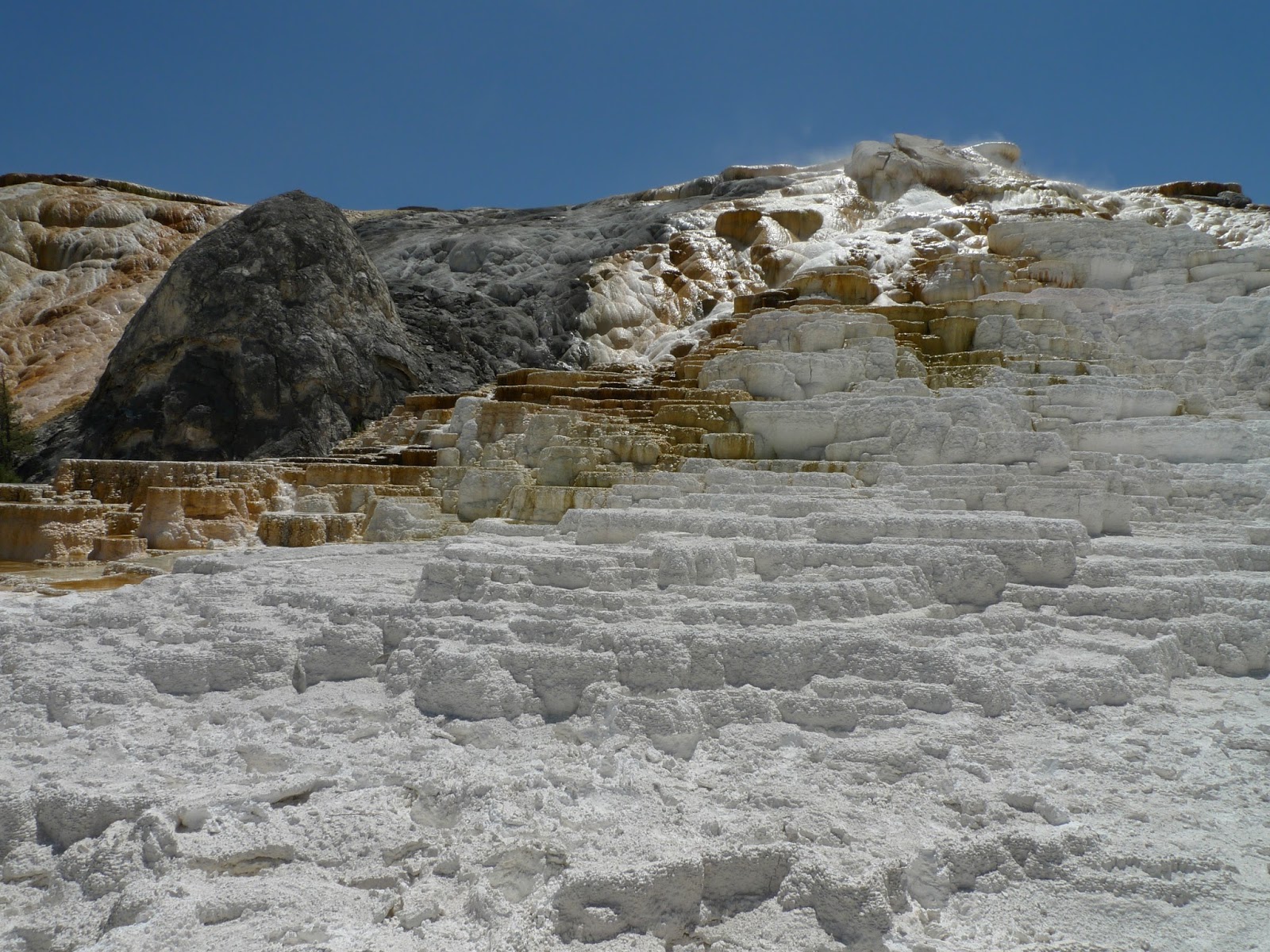
travertine terraces,
 Grand Prismatic Spring,
and of course, Old Faithful.

Get outside and enjoy your National Parks, everyone!